
Pick the water, then build the trip around it
A first African fishing trip becomes easier when it has one clear purpose: cast for tigerfish on the Zambezi, learn a trout presentation in South Africa, or stalk bonefish on a Seychelles flat. Those are separate fisheries with different seasons, access arrangements and tackle. Combining them in a short itinerary usually reduces the time available to learn any one of them.
For tigerfish, distinguish the Upper Zambezi above Victoria Falls from the Lower Zambezi below Kariba. In South Africa, Dullstroom in Mpumalanga offers managed trout stillwaters, while Rhodes in the Eastern Cape is a base for mountain-stream fishing. For Seychelles flats fishing, the Alphonse group and St François are documented guided destinations. A named destination establishes where a fishery exists; it does not grant permission to fish every bank, lodge water or island flat.
All tackle numbers and presentation sequences below are practical starting suggestions. Adjust them to the fish size, current, wind and operator's conditions. The aim is a repeatable presentation, not a promise of a particular catch rate.
The fish and the food that matters
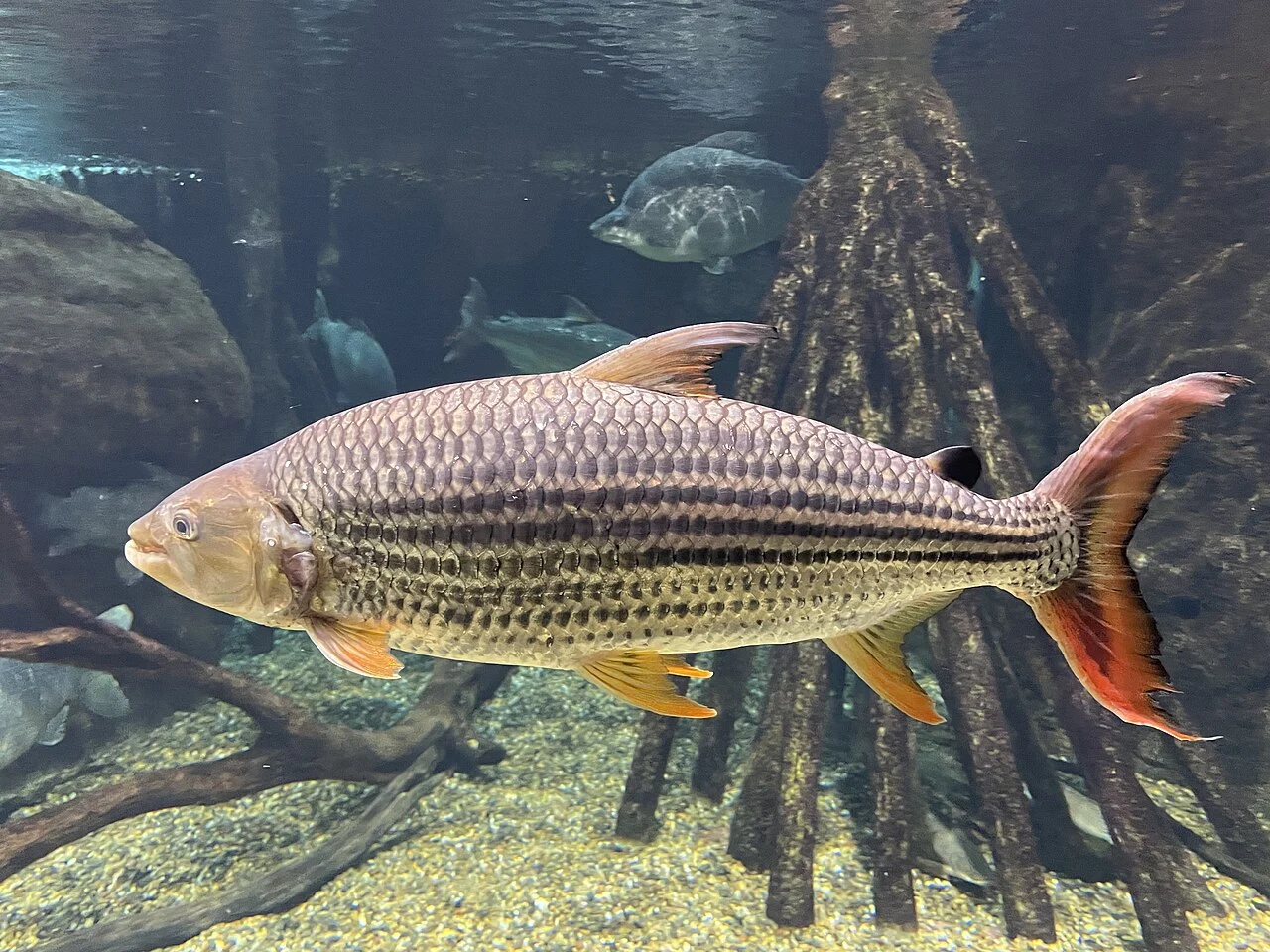
The Zambezi tigerfish in this guide is Hydrocynus vittatus, not the Congo basin's goliath tigerfish, Hydrocynus goliath. Look for the elongated silver body, dark horizontal striping and prominent teeth, then confirm identification with your guide. Warm, well-oxygenated river channels and adjoining feeding areas are more useful starting habitat than an indiscriminate search of still muddy backwaters.
Tigerfish do not eat the same food throughout life. Simasiku and colleagues' 2017 study in Namibia's Kalimbeza Channel found more aquatic insects in smaller fish and substantial fish prey in larger specimens, including Synodontis catfish, Brycinus and Micralestes. Diet also varied seasonally. That is evidence from a particular Zambezi channel, not a menu for every lodge pool, but it explains why a baitfish silhouette is a sensible adult-tigerfish starting point.
South African trout fisheries include introduced rainbow trout, Oncorhynchus mykiss, and brown trout, Salmo trutta. Rainbows commonly show a pink lateral stripe and spotted tail; browns often have red and dark flank spots. Both identification and stocking vary by water. Insects are important trout forage, with small fish and other animals also relevant in some conditions. Look for actual rises, emerging insects or fry rather than assuming a famous fly is always appropriate.
The Seychelles bonefish featured here is roundjaw bonefish, Albula glossodonta, an Indo-Pacific species, rather than automatically the Atlantic bonefish Albula vulpes. It feeds over sand and mud, taking benthic animals including shrimps, crabs and worms. A small underslung mouth suits picking food from the bottom. A cruising fish may be travelling; a tailing or mudding fish is a stronger clue that feeding is occurring at that spot.
Match the structure to a presentation
| Example water or condition | Likely target | Food or holding reason | Method or lure | Presentation | Caveat |
|---|---|---|---|---|---|
| Zambezi channel margin or island seam | Tigerfish | Small fishes pass a current boundary | Spoon or shallow minnow | Cast across the seam and keep the lure swimming under tension | Do not assume fish are in the fastest flow |
| Zambezi drop-off beside a quieter margin | Tigerfish | Depth near a possible feeding route | Sinking lure or weighted streamer | Test progressively longer countdowns | Debris and current can make bottom contact unhelpful |
| Dullstroom dam weed edge or depth change | Stocked trout where present | Cover near aquatic insects and other prey | Nymph or small streamer | Retrieve parallel to the edge at measured depth | Avoid warm, oxygen-poor water and obey the fishery's method rules |
| Rhodes stream riffle entering a pool | Rainbow or brown trout | Drifting insects meet slower holding water | Single nymph or dry fly | Work upstream with a drag-free drift | Access is managed; conditions differ between beats |
| St François sandy flat beside a channel | Bonefish | Bottom prey and a route onto or off the flat | Shrimp or small crab fly | Lead a visible fish, sink the fly and make short strips | Tide height alone does not predict feeding |
| Clear shallow flat with cautious fish | Bonefish | Fish can inspect a presentation closely | Lightly weighted fly | Quiet cast with minimal movement until noticed | Heavy flies can land too loudly or bury in soft sediment |
Use this table to form a hypothesis, then test it. An eddy may retain baitfish, but a flat, empty slack-water patch may offer little. A weed edge combines food and shelter only if the fish can use its depth and oxygen conditions. A flats channel is a route, not a permanent congregation point.
Tigerfish: protect the leader and control the swing
For moderate river fishing, start with a 2.1–2.4 m medium-heavy rod, a matched spinning reel around the 4000 size class, and 20–30 lb braid. Reel-size labels vary between manufacturers. Join the braid to 1–1.5 m of 30–40 lb abrasion leader, then add a 20–30 cm wire bite trace of roughly 30–40 lb. Attach it with the wire maker's recommended knot or crimp and use a strong lure connection. Ordinary fluorocarbon is not reliable protection against tigerfish teeth.
A 15–25 g spoon or an 8–12 cm minnow makes a manageable first lure. Choose a strong single-hook version where practical, with hook size matched to the lure so it retains its action. Cast across and slightly upstream of a seam, close the bail and remove slack. Let the current assist the lure's path while retrieving fast enough to keep it working. Test the action beside the boat first: uncontrolled spinning or rolling means you should reduce speed or change the lure.
Begin above submerged timber rather than deliberately dragging through it. If nothing responds, count the next sinking lure down for a few seconds longer while keeping light contact. Once repeated snags begin, shorten the countdown or alter the angle. A deeper lure is useful only if it passes through fishable water.
A fly alternative uses an 8- or 9-weight rod, suitable floating or sinking-tip line, a short stout leader and the same bite protection. Try a 7–12 cm baitfish streamer on a strong size 1/0–3/0 hook. Strip with the rod low and pointed at the fly. When the line comes tight, make a firm line-hand strip set, then let the rod cushion runs and jumps. On spinning tackle, reel out slack before a controlled sideways sweep; striking against slack achieves little.
Falling floodwater can draw forage back toward channels, but the timing differs between Upper and Lower Zambezi and between years. Start with the guide's current water-level observations. Early or late light is worth testing, while a shaded seam with active bait can remain worthwhile later. Try silver or dark-backed baitfish patterns first; in stained water compare a stronger silhouette or more vibration. Colour cannot compensate for a lure passing above the fish.
Trout: two rigs for different water
For Dullstroom stillwaters, a 9 ft, 5- or 6-weight fly rod, floating line and a 2.7–3.6 m tapered leader ending in approximately 5–8 lb tippet provide a useful base. Tie on one size 10–14 nymph or a size 8–10 olive or black streamer. The nymph suggests small aquatic prey; the streamer is a searching alternative when fish will move to a larger target. These examples use artificial flies, not natural bait, which is inappropriate for a fly-only venue.
Fan short casts across the nearest margin before reaching farther out. Allow the fly to sink for a counted interval, then retrieve with slow hand-twist movements or short 10–20 cm pulls. Keep the rod tip near the water and watch the line for a twitch, stoppage or unexpected tightening. Lift smoothly into a take. If the fly repeatedly returns with weed, shorten the countdown or move to an open lane alongside the vegetation. If there is no contact, increase depth before changing colour.
For a permitted Rhodes stream beat, change to a lighter presentation: a 4- or 5-weight rod, floating line, about 3 m of leader and roughly 3–5 lb tippet. A single size 12–16 nymph is a good starting search fly. Cast upstream of a pocket behind a rock, lift excess line and follow the drift. Mend before the line pulls the fly across the current. Lift at an unexplained pause. When fish rise, replace it with a comparably sized dry fly and deliver it without dragging.
Cold conditions can slow the response and shift activity toward warmer parts of the day. Strong sun or warming water can make shade and depth more relevant, but deeper water is not automatically well oxygenated. Ask the fishery about current conditions; do not persist with stressed trout just because the holiday is booked.
Bonefish: rig for a quiet, visible approach
A 9 ft, 8-weight saltwater fly rod with a matching floating line and a reel carrying adequate backing is a practical bonefish outfit. Connect a 3–3.6 m tapered leader ending in 12–16 lb tippet. Tie on a size 4–6 shrimp or small crab fly, with bead-chain eyes for shallower water or modest dumbbell eyes when more sink is needed. Choose a pattern designed to fish hook-point upward so it can cross sand with fewer fouls.
Use the bottom as the first colour reference: tan or pale patterns are reasonable on light sand, with a darker pattern available for contrast. This is a visibility experiment, not a proven universal colour rule. The fly's landing noise, sink rate and movement often make a more useful adjustment.
Stand still and identify the fish's travel direction before casting. With the guide's help, land the fly roughly 1–2 m ahead and a little to the side of a cruising fish, adjusting for depth and speed. Let it reach the bottom, then use short strips only when the fish can notice it. If the fish follows, a pause may make the fly easier to take. If it bolts at every cast, lead farther away or use less weight.
Keep the rod low. When the line tightens, strip firmly until the fish is hooked, then clear loose line and let the reel's drag work. Lifting immediately as though striking a trout can pull the fly away. As the tide changes, search the edges and cuts that still carry enough water rather than following a fixed clock. Bright overhead light can improve sighting; moving water and feeding behaviour determine whether that visibility produces opportunities.
A worked tigerfish session and useful changes
Ask the guide to identify three fishable structures: an island seam, a channel edge and a quieter margin with bait. Start with the spoon and wire-trace spinning outfit. Make several casts to the closest lane, then across the seam, noting the countdown and current angle. Work a manageable section thoroughly rather than making long uncontrolled casts.
After about 15–20 minutes without contact, change one variable: try a minnow nearer the surface, or a longer countdown if the guide expects deeper fish. A follow without a strike suggests a different speed or smaller profile; repeated snags suggest the wrong track. If two distinct presentations fail, move to another structure type. Record the combination that produces contact so you can repeat it.
Local rules and a short handling note
Arrange Zambia's applicable fishing permissions and any protected-area conditions through the Department of Fisheries and your operator; catch-and-release does not itself prove an exemption. In South Africa confirm the specific fishery or Wild Trout Association beat permit, access and method restrictions. Seychelles' 2025 Fisheries and Aquaculture Act provides a recreational permit exemption subject to regulations, with exclusions for commercial use of catches; confirm current zoning and operator permissions with the Seychelles Fisheries Authority. None of these general provisions makes every named water freely accessible.
Stay in the boat around unfamiliar Zambezi banks and wildlife, use flotation, and follow the guide's flats exit route as tides change. Support fish in the water where possible, use tools around tigerfish teeth, and release promptly. Avoid prolonged air exposure or holding any large fish by the jaw alone.