
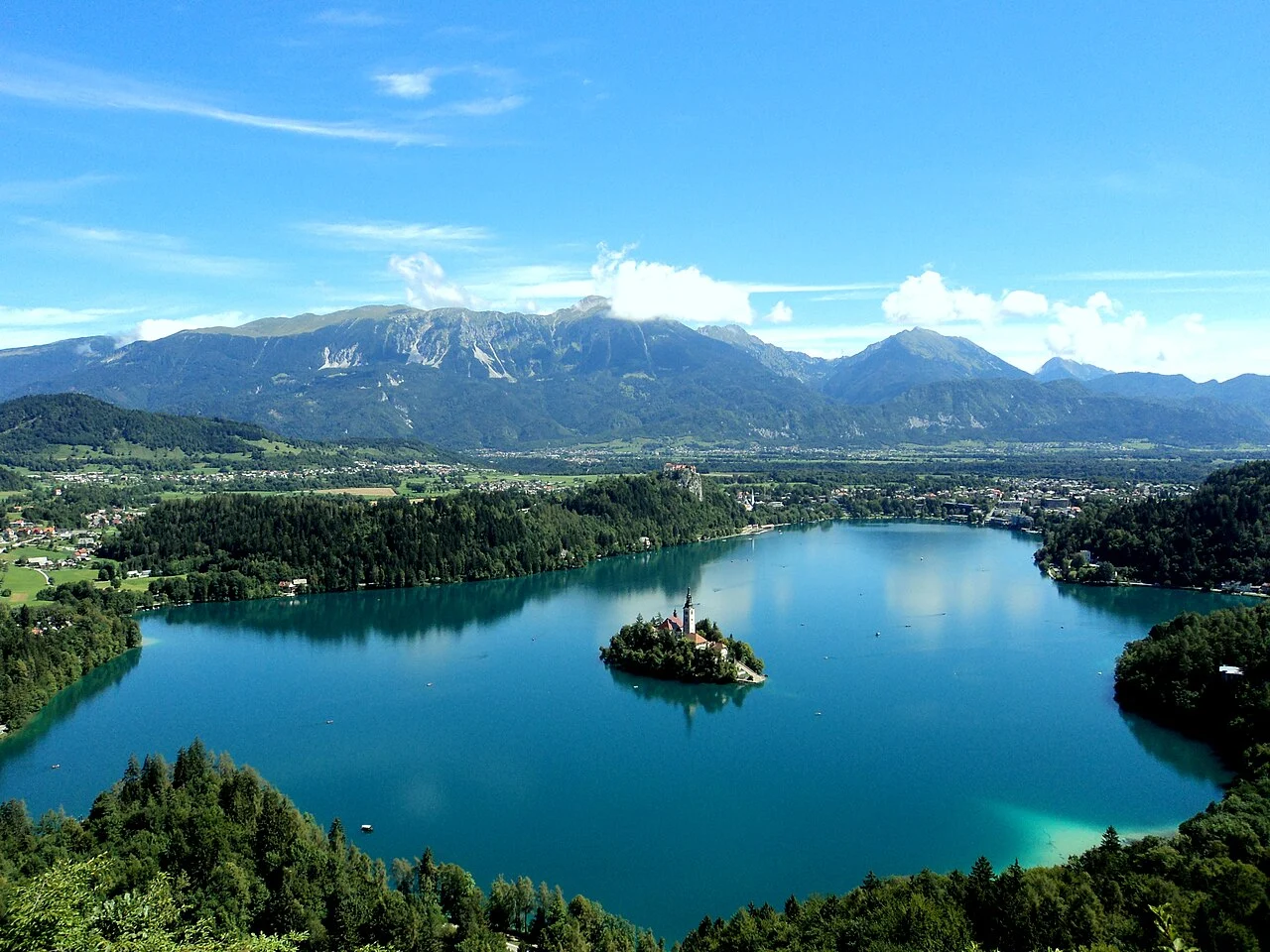
A first Central European fishing trip works best when you choose between two kinds of control: keeping a fly in a river's feeding lane, or presenting a bait accurately beside a quiet lake margin. Austria's Alpine rivers, Slovenia's Soča basin and managed Czech ponds offer different versions of those lessons. They are not interchangeable fisheries, and a permit for one does not authorize another.
The examples below retain that regional scope. Lake Bled, shown in the cover, is geographical context, not a promise of unrestricted fishing from its shoreline. The numbered tackle sizes and depths are practical starting suggestions. Match them to your permitted water, actual fish size and casting ability.
Choose a base with the right kind of water
The Möll in Carinthia is a documented Austrian grayling destination; the Bregenzerwald offers trout waters. Arrange a named beat through its fishery manager or accommodation with fishing access. Ask which bank, boundaries and parking belong to the booking. A village name alone cannot establish where you may cast.
Tolmin is a useful Slovenian base for the Soča and tributaries managed by RD Tolmin. The district's published map, permit and river-specific rules are the starting point. The Soča around Kobarid and Tolmin differs markedly from a steep tributary gorge. Choose a reachable gravel-bank run for learning rather than treating clear water as evidence that a deep crossing is safe.
For a Czech stillwater example, Hejtman near Chlum u Třeboně offers managed recreational fishing through Rybářství Třeboň. Use the operator's bank-access map. Its 2026 rules prohibit fishing from boats and from the dam, and some shore parcels are excluded. These details change the plan: this is a permitted-bank session, not an invitation to launch a float tube or walk into private gardens.
Read the structure before choosing a rig
| Water and feature | Fish example | Food or holding reason | Method | Presentation | Caveat |
|---|---|---|---|---|---|
| Möll or permitted Soča-basin gravel run | European grayling | Bottom invertebrates delivered by current | Single nymph | Short upstream drift through one seam | Species and fly rules depend on the beat |
| Soča-basin smooth glide with rising fish | Grayling or trout | Aquatic insects reaching the surface | Dry fly | Drift without skating across current | A rise does not prove species identity |
| Deep Soča-basin pool beside boulders | Larger marble trout | Cover and access to fish prey | Single streamer where allowed | Swing past the pool edge, then strip | Not an excuse to target spawning fish |
| Czech managed pond, firm margin beside reeds | Common carp | Benthic food and shelter nearby | Float and small bait | Place bait on or just above bottom | Keep the hook clear of stems |
| Same pond, reachable clean bottom beyond the margin | Common carp | Searchable bottom feeding route | Running leger | Let bait settle, maintain light contact | Avoid a fixed weight that can tether fish |
A current seam is the boundary between water moving at different speeds. An eddy turns back on itself; its outside edge may offer a more predictable drift than its spinning centre. Riffles are shallow, broken water over rough substrate. Pools are deeper and usually slower, but their entrances and exits can carry strong flow. An undercut bank gives overhead cover; wood and boulders create both shelter and snag risks. Treat each as a different casting problem.
A tributary mouth can mix temperature, clarity and food, but it is not automatically a productive or open fishing spot. Likewise, a quiet weed edge holds interest only if the target fish and suitable conditions occur there. The examples in the table do not imply that every listed species lives in every Central European river.
Grayling and trout: know what is feeding
European grayling, Thymallus thymallus, have a conspicuously tall dorsal fin. They differ from brown trout, Salmo trutta, and introduced rainbow trout, Oncorhynchus mykiss. Soča-basin grayling are of particular conservation interest. Marble trout, Salmo marmoratus, can be confused with hybrids of marble and brown trout; appearance alone may not settle an uncertain identification.
Grayling take bottom invertebrates and aquatic insects, sometimes fish larvae. A nymph drifting just above stones imitates food available below the surface; a dry fly is a better choice when fish repeatedly intercept floating insects. Small marble trout also consume bottom organisms and insects, while larger individuals increasingly eat fish. That makes a streamer a reasonable alternative in suitable water, not a guarantee that the deepest pool contains a large trout.
In Alpine catchments, snowmelt and rain can change flow and visibility rapidly. A cold, fast run may demand shorter drifts in softer margins. In clearer, lower water, reduce disturbance and lengthen the approach rather than automatically making the fly smaller. In hot low flows, seek the manager's temperature guidance and stop trout fishing when conditions are unsuitable. A calendar season does not establish a safe thermal window.
Assemble and fish a single-fly setup
Start with a 9-foot, 4–5-weight fly rod, matching floating line and a reel with a reliable drag. Attach a 2.7–3.6 metre tapered leader, finishing with 60–90 cm of approximately 0.16–0.20 mm tippet, often around 4–6 lb depending on material. Tie on one barbless size 12–16 nymph. Use a properly seated knot, trim its tag and test it before casting. For larger trout, heavier water or bigger flies, strengthen the tippet rather than prolonging the fight on delicate tackle.
At Tolmin, fly fishing with a fly line is required, additional weights are prohibited, and only one single-hook barbless fly, nymph or streamer is allowed. Ask the manager which weighted fly patterns meet its interpretation; do not add split shot. Under its catch-and-release permit, indicators are limited to wool/yarn or soft mouldable putty. The Koritnica and Kneža are dry-fly-only waters. Those constraints materially determine which of these techniques you can use.
From downstream of a feeding lane, cast a little upstream and keep most line out of the faster current. Follow the fly with the rod rather than pulling it. Watch the leader or permitted indicator for a hesitation or sideways movement; raise the rod smoothly to tighten. A fly that repeatedly catches one rock needs a shorter drift, different casting angle or lighter pattern. Simply increasing weight can make the same problem worse.
For the dry-fly alternative, replace the nymph with one size 14–18 floating insect imitation and use no sinker. Pick a size and outline close to insects actually visible. Place the fly upstream of a rising fish with enough loose leader for a natural drift. Allow the fish to close its mouth before lifting gently. If the fly skates, repair the line angle or shorten the cast before trying another pattern.
For a streamer in an allowed main-river reach, use a stronger 8–10 lb tippet and a single barbless size 6–10 baitfish imitation. Cast across and slightly downstream, let it swing near a pool margin, then add short strips separated by pauses. Keep contact through the swing and tighten into a take. This outfit is for modest presentations in controllable water; specialist large-marble-trout fishing requires a stronger matched setup and local instruction.
A pond session: present a bait where carp can find it
Common carp, Cyprinus carpio, are not grass carp. Their natural diet includes bottom invertebrates and plant material; a feeding fish may disturb sediment, but a patch of bubbles alone does not prove carp are present. Look for moving fish, repeated activity near an edge, or a change from soft silt to firmer bottom.
Use a roughly 3–3.6 metre float rod, 3000-size reel and 6–8 lb monofilament for small-to-medium fish in open water. Choose stronger tackle or another position if substantial carp can reach heavy cover. A size 10–14 hook suits a small permitted worm section or one or two grains of sweetcorn; hook gape and bait size matter more than the printed number.
For a simple float rig, fix a small waggler by its lower eye, with locking shot around that attachment and smaller shot spaced below. Add a 30–45 cm hooklength slightly weaker than the main line. Plumb the depth with a removable plummet, then remove it before fishing. Set the float so the bait starts just on the bottom without a long length of line lying in weed.
Cast gently beyond the chosen patch, draw the float into position and sink excess surface line. Watch for a steady movement, a lift or a deliberate submergence, then tighten with a controlled sweep. Tiny repeated taps may be small fish or bait interference. Check that the hook point remains exposed and the bait has not slipped over it.
If surface drift prevents useful float control, try a running leger on a suitable rod. Slide a 10–20 g free-running weight onto the main line, then a protective bead; tie to a swivel and attach a 40–60 cm hooklength with the same baited hook. The weight must slide freely if the main line breaks. Cast to clean bottom, let it settle and tighten only enough to see a bite on the tip. Reel down and lift when the pull becomes sustained.
Start with hook bait alone at Hejtman. Its published feeding clause contains both restrictive wording and listed exceptions; obtain the manager's clarification before introducing groundbait or using feeding equipment. Natural bait belongs in this pond example, not on a fly-only Alpine beat. For clear-water fly choices, begin with a subdued insect or fish outline; in colored water, test a more visible profile. Neither a bright fly nor sweetcorn makes up for the wrong depth.
Put the first two hours in order
On a river, spend the first ten minutes watching the near margin from the bank. Fish it before wading. Make several short drifts through one lane, then move the cast progressively outward. After a dozen controlled drifts without interest, compare a second depth or neighboring seam. Use a dry fly only when the water and rules suit it, and reserve a streamer trial for a distinct fish-prey or pool-edge question.
At a pond, measure two reachable depths and begin beside the nearer clean margin. If the bait disappears untouched into soft sediment, shorten the float setting or move to firmer ground. If small fish repeatedly steal it, use a more durable permitted bait. After roughly twenty minutes without a useful sign, test the second depth before changing the whole outfit. When a fish takes, note depth and position and repeat them.
For an open-season Tolmin session, a workable example is a 5-weight rod, floating line, 3-metre leader and single barbless nymph in a permitted Soča reach. Fish near seam, middle seam and pool entrance in that order. Change to a dry fly when repeated surface feeding makes the choice meaningful. This is an example sequence, not a report of fish currently feeding there.
Brief rules and handling notes
Checked November 1, 2026: RD Tolmin's main catch-and-release season ends November 1, with different lake dates and exclusions; do not extend a river ticket into November by assuming the reservoir's rules apply. Austria requires the appropriate state and water permissions. Czech fishing districts generally require a state licence and water permit, while the named managed-pond arrangement has its own authorization and rules. Use the current manager links below for the exact dates and boundaries.
Avoid spawning gravel, unstable banks and unsafe wading. Use a suitable net, wet hands and prompt unhooking; support carp on a wet unhooking mat if they must leave the water. Keeping the session controllable protects fish and makes the lesson easier to repeat.