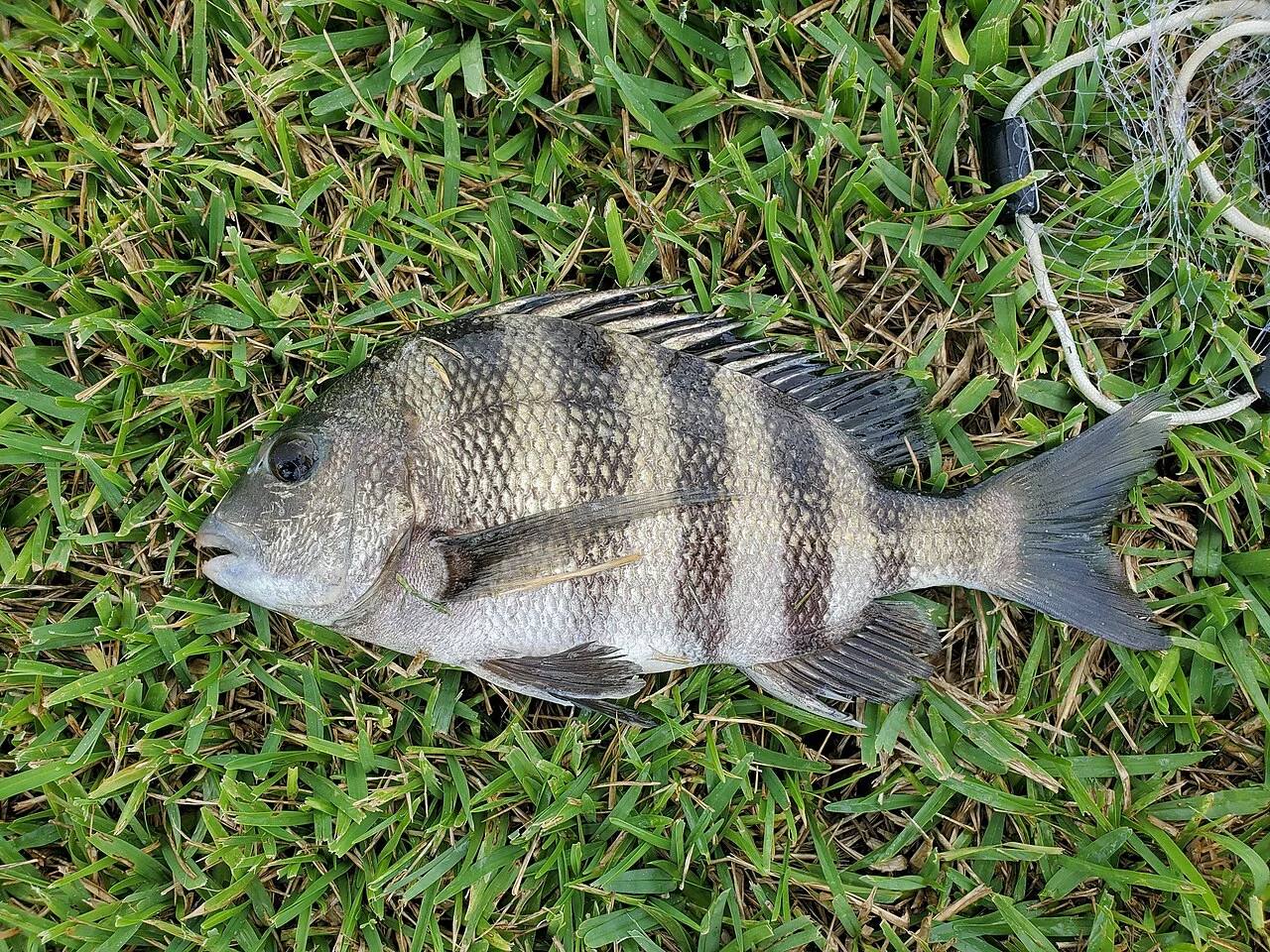
Sheepshead, Archosargus probatocephalus, are deep-bodied western Atlantic porgies with dark vertical bars, strong incisor-like front teeth and crushing molars. They are not freshwater sheephead, a name sometimes used for freshwater drum, and they are not black drum. Juvenile black drum can carry dark bars, but black drum generally have barbels under the chin and a longer, less porgy-like profile. Confirm identification from the whole fish before applying a limit.
Georgia supports sheepshead around oyster reefs, bridge pilings, docks, jetties, breakwaters and nearshore artificial reefs. The Georgia management plan describes them as euryhaline fish that favor oyster reefs and man-made hard structure, feeding on oysters, barnacles, shrimp, other decapods and encrusting animals. Winter can concentrate effort around structure, but the exact depth and location shift with temperature, tide, clarity and bait availability.
Why hard structure matters
A piling is more than shelter. Current striking the upstream face accelerates around the sides and produces a slower pocket downstream. Barnacles, oysters and small crustaceans grow on the hard surface. A sheepshead can hold close to the food while spending less energy in the lee.
An oyster edge provides both forage and a boundary. A rising tide floods higher shell and marsh margins; a falling tide drains water through cuts and off flats. Fish may use the first drop beside the shell rather than sit on top of exposed oysters. Jetties add vertical faces, boulder gaps and strong current. Nearshore reefs offer relief in deeper water, but require safe boat positioning and precise depth control.
The key decision is to connect structure, current and presentation. Do not simply drop beside every piling. Identify the current-facing edge, the side seam and the downstream pocket, then present bait through each zone.
Tackle and rigging
For inshore docks and bridges, a medium spinning outfit with abrasion-resistant leader is a practical starting point. Main line and leader strength must match structure and current. Around relatively open oyster edges, many anglers can begin near 10–20 pound main line and 15–30 pound leader. Heavy pilings, fast current or large fish justify stepping up. These are starting ranges, not fixed prescriptions.
Use a small, strong hook that fits the bait and leaves the point exposed. A compact knocker rig places a sliding sinker directly above the hook; it keeps the bait near structure and transmits subtle bites. A Carolina-style rig separates the sinker from the bait and can allow a more natural movement along an oyster edge. A small jighead provides direct contact for a crab, shrimp or compact soft bait.
Select the lightest weight that reaches the strike zone without sweeping away. In a protected dock pocket, that may be a fraction of an ounce. At a deep bridge piling, one or more ounces may be required. Increase weight in small steps until the line remains near the chosen face. Too much weight wedges into shell and makes a fish feel resistance; too little carries the bait past the target before it reaches depth.
Fiddler crabs, small pieces of shrimp and locally legal shellfish baits can work. Georgia DNR’s winter guidance specifically mentions fiddler crabs and oysters for sheepshead. Do not collect oysters or crabs without checking the separate shellfish and bait rules, area status and required license or Saltwater Information Permit. Buying bait simplifies compliance.
Presentation: close without becoming stuck
At a piling, lower the bait on the upstream corner and let it descend along the face. Keep enough tension to feel the sinker, but do not pendulum the bait away from the structure. Pause at visible barnacle bands, then continue. Repeat on the side seam and downstream pocket.
At an oyster edge, cast slightly up-current so the rig settles near the drop. Use short lifts of a few centimetres to clear shell, then hold. A sheepshead bite can feel like pressure, a small tap or simply added weight. Lift firmly and reel; a huge sweeping hook-set often pulls a small hook free.
At a jetty, fish the near rocks before making long casts. The base of the visible wall, submerged steps and sand-rock transitions are distinct lanes. Cast across-current only when you can keep the line away from other anglers and waves. If the sinker repeatedly wedges, change angle, reduce weight or use a more compact rig rather than repeatedly breaking off line.
A structure comparison
Piling: concentrated vertical forage, sharp current edge, precise vertical drop, high abrasion risk.
Oyster bar: broad feeding edge and drain, cast to the first drop, high snag and shell-cut risk.
Jetty: rock gaps and depth changes, work near-to-far, wave and footing hazards.
Artificial reef: deeper distributed structure, vertical or drift presentation, requires current-aware boat control.
Do not imply every structure holds fish. Fresh scrape marks, intact barnacles, moving water and bait activity are reasons to test a place, not proof.
A worked four-hour plan
Start during a period with manageable current rather than automatically choosing maximum flow. At the first dock, inspect eight to ten pilings. Make two drops on the upstream face, two along a side seam and one into the downstream pocket. If nothing happens, move; sheepshead fishing rewards contact with multiple pieces of structure.
During the second hour, compare a deeper piling with a shallow oyster edge. Keep bait, hook and leader constant while changing only sinker weight and depth. Record where taps occur relative to current. If bites happen halfway down rather than at bottom, mark that line depth and repeat it.
During the third hour, refresh bait frequently and inspect the hook after every shell contact. A dulled point is a hidden reason for missed fish. If small taps remove bait, reduce bait size, shorten the exposed tail and hold the rod rather than leaving it unattended.
In the final hour, return to the best current position. If tide direction has reversed, fish the opposite side of the same structure. A piling that was unproductive can become useful when its slack pocket changes sides.
Rules and ethical handling
As checked on 26 October 2026, Georgia DNR listed sheepshead open all year, with a 10-inch fork-length minimum and a daily limit of 15. Those facts must be rechecked on the live DNR page before fishing because rules can change. Anglers age 16 and older generally need a Georgia fishing license, and saltwater fishing requires the state’s current Saltwater Information Permit requirements to be followed.
Measure fork length correctly from the most forward point of the head to the fork in the tail. Do not stretch or pinch the tail to create a legal fish. If retaining a legal fish, place it on ice promptly. If releasing, wet hands, support the body and minimize air exposure. A fish hauled from deeper nearshore structure may need careful barotrauma handling under applicable rules; for most shallow piling fish, fast unhooking and a direct return are the priority.
Avoid scraping large areas of living oyster or removing barnacles merely to “chum.” Oyster reefs are habitat and shoreline protection. Pack out cut line and hooks. Give bridge traffic, private docks and working waterfronts room.
Common mistakes
A common mistake is fishing too far from the structure. A bait one metre from a piling can be outside the narrow feeding lane. The opposite mistake is forcing the rig into a crack; contact should be close, not buried. Another error is waiting for a dramatic run. Watch for small weight changes and keep the line controlled.
Do not confuse juvenile black drum with sheepshead. Check for chin barbels, body form and the mouth. Do not assume a fish with bars is automatically a sheepshead. Finally, do not use old limits from a tackle-shop sign or screenshot; open the current Georgia DNR regulations.
The cover image is a verified photograph of Archosargus probatocephalus, with the deep body, dark bars and porgy profile visible. It is representative species context, not a claim of a Georgia catch or handling demonstration.
Prepublication check
Geography: Georgia coastal waters and state sources are explicit. Habitat and structure: oysters, piers, pilings, jetties and artificial reefs are differentiated. Forage: oysters, barnacles, shrimp and crustaceans are sourced to Georgia management material. Methods and lures: crab/shrimp bait, knocker and Carolina rigs, jigheads, weight control, cast angle and bite response are explained. Examples: a four-hour plan and structure comparison are included. Sources and rules: live 2026 Georgia DNR pages were checked. Image match: Commons metadata identifies the fish as sheepshead and the registered asset is unused.