
Start with a fish and a manageable day
A first fishing trip in the Middle East works best when the boat, target and method fit together. A few hours casting or trolling for coastal kingfish from Abu Dhabi is a different undertaking from heavy popping for giant trevally off southern Oman. Choose the kind of fishing you can perform accurately for several hours, then choose a departure point and season that support it.
Abu Dhabi's documented charter departures include Al Bateen, the Corniche area and Al Bandar. These are departure options, not permission to cast anywhere inside a marina. In southern Oman, Hasik is a charter base for inshore water and the Hallaniyat Islands. Confirm the precise meeting point, fishing area and access with the operator before travelling. A public beach, harbour wall or island on a map is not automatically an unrestricted fishing spot.
The rigs, lure sizes, countdowns and speeds below are practical starting suggestions for discussion with the skipper. They are not legal limits or guaranteed local formulas. Match every lure to the rod's casting range and every leader, hook and connection to the expected fish and structure.
Identify kingfish before applying kingfish advice
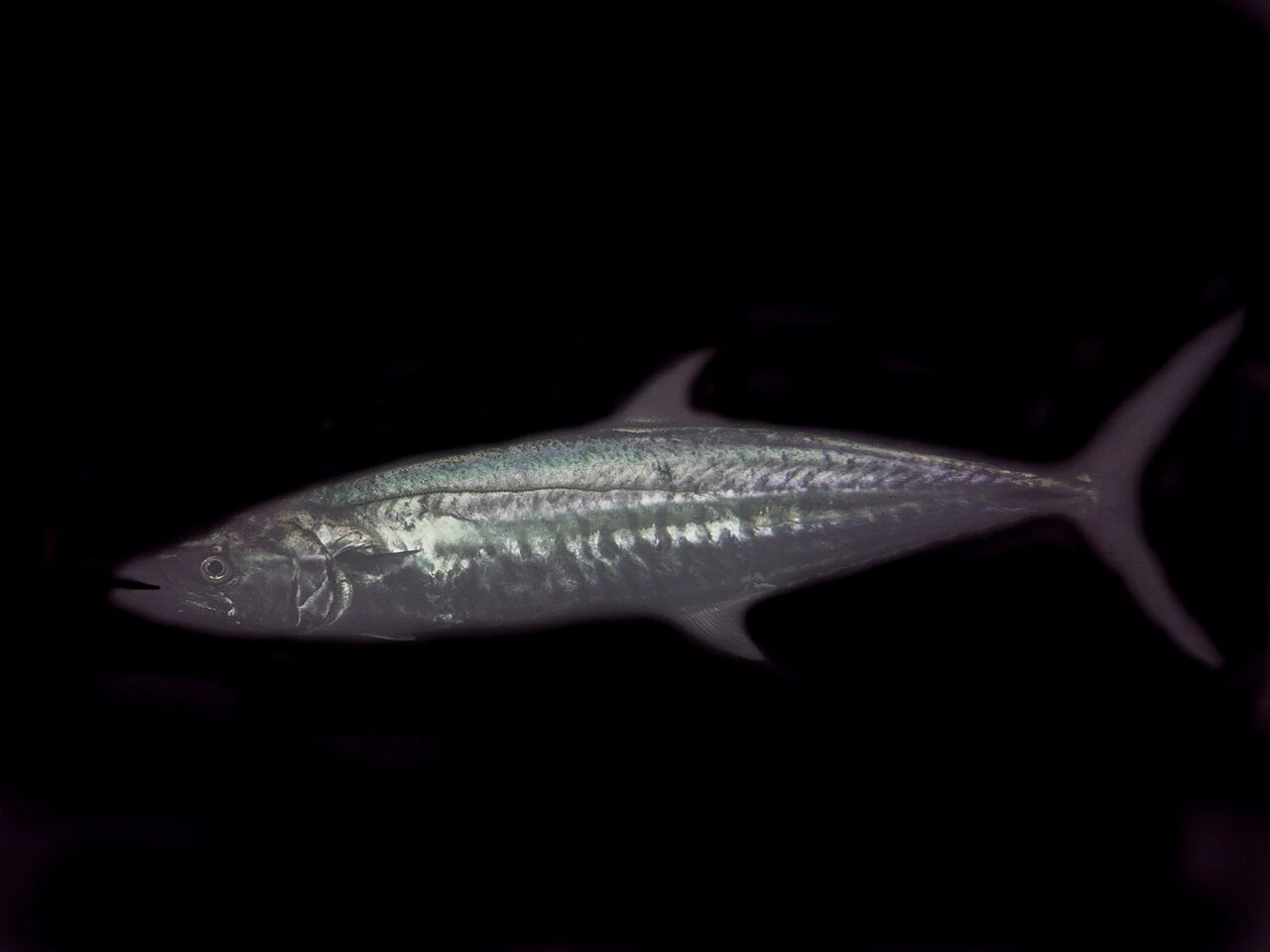
The coastal kingfish featured here is narrow-barred Spanish mackerel, Scomberomorus commerson. It is an Indo-West Pacific species, not the western Atlantic king mackerel Scomberomorus cavalla, and not the yellowtail called kingfish in parts of Australia and New Zealand. Its long body carries many narrow, wavy vertical bars. The lateral line drops abruptly below the second dorsal fin. Wahoo can look similar at a glance, so have the skipper confirm the full identification rather than relying on bars alone.
This mackerel hunts other fishes, including anchovies, herrings and related schooling prey, and also takes squid and crustaceans. Coastal reefs, shoals and adjoining open water can put that forage within reach. A fish seen at the surface may be feeding above a much deeper bottom: the useful fishing depth is the prey layer, not necessarily the seabed.
Giant trevally, Caranx ignobilis, is a deep-bodied jack with a strong tail and scutes along the rear lateral line. Several other trevally species occur around the islands; a small trevally is not automatically a juvenile GT. A 2024 study of giant trevally from Kerala documented fish, crustaceans and molluscs in its diet. That supports a broad predatory feeding model, but its proportions and seasonal results should not be transferred directly to Oman.
Read bait, current and structure together
| Structure or condition | Possible target in this region | Food or holding reason | Method or lure | Presentation | Caveat |
|---|---|---|---|---|---|
| Coastal bait school beside a reef edge | Narrow-barred Spanish mackerel | Concentrated small fishes over nearby depth | Metal casting lure or minnow | Cast beyond the school and retrieve across its edge | Driving through the school can scatter the opportunity |
| Open-water contour with recurring bait marks | Spanish mackerel where present | A route linking separate prey groups | Diving trolling minnow | Track the bait depth at a speed that preserves lure action | A productive bottom contour alone does not prove bait is present |
| Tidal channel edge with manageable flow | Mackerel or other local predators | Moving prey alongside slower water | Unweighted bait or shallow lure | Drift alongside the edge with controlled line tension | Use only permitted areas and legally sourced bait |
| Hallaniyat rocky point or reef shoulder | Giant trevally where present | Current and structure can concentrate prey | Surface popper or stickbait | Cast to the fishable edge and bring the lure toward open water | Heavy tackle and room to fight are essential near reef |
| Deeper reef or pinnacle with fish marked above it | Trevallies or other locally identified predators | Cover beside a feeding layer | Metal jig | Work above the reef with controlled lifts and falls | Do not assume every mark is the intended species |
Start by looking for moving bait, working birds or a repeated sounder pattern. Birds indicate activity, not a guaranteed target fish. Compare the up-current shoulder, the current boundary and the quieter lee. If the boat drifts too quickly to hold a useful presentation, change the drift or lure weight rather than paying out endless line.
A complete kingfish casting setup
A 2.1–2.4 m medium-heavy spinning rod rated for approximately 20–60 g lures, a compatible 4000–6000 size-class reel and 20–30 lb braid make a useful moderate outfit. Reel labels differ between brands; line capacity and usable drag matter more than the number printed on the reel. Join the braid to about 1.5–2 m of 30–50 lb abrasion leader, then fit a short 20–30 cm wire trace of roughly 30–50 lb for tooth protection.
Use the wire manufacturer's recommended knots or crimps, inspect them under load and keep the lure connection compact. A heavy, kinked trace can impair a small lure's action. Fluorocarbon alone is not reliable bite protection. Replacing damaged wire promptly is more useful than hoping it will survive one more fish.
Start with a 20–40 g metal lure or a 10–14 cm minnow with strong, correctly matched hooks. Cast past the visible bait rather than into its centre, then retrieve through the outside edge. Let a metal lure sink on light contact for a short count before winding; increase that count only when the fish appear lower. Use a steady retrieve with occasional short acceleration, or twitch a minnow and pause briefly without losing all contact.
If the lure skips out of the water, lower the rod tip, reduce speed or use a more suitable shape. If fish follow without committing, test a smaller profile or a longer pause. A bite may feel like a sudden stop, sharp impact or slack as a fish moves toward the boat. Reel tight and make a controlled sweep with a conventional lure hook, then let the drag absorb the first run.
Silver or blue-backed baitfish colours are reasonable clear-water starting choices. A darker silhouette or a brighter finish is worth comparing when visibility is poor. These are tests of contrast, not established rules that a particular colour always works at dawn or on a particular tide. Profile, depth and clean swimming action come first.
Trolling and bait: alternatives when casting is ineffective
For a trolling minnow, use the same basic abrasion leader and wire protection on a rod and reel suitable for the lure's pull and the expected fish. A 12–16 cm diving minnow offers a useful starting profile. Its depth depends on lip design, line diameter, line out and speed; do not label it a fixed-depth tool simply because a depth appears on the packet.
Begin around 4–6 knots only if the lure swims cleanly there, then adjust to the manufacturer's range and observed action. Check beside the boat before setting it back. A lure that rolls, jumps or vibrates irregularly needs adjustment. Follow the edge of a bait concentration, with enough separation between lines to avoid tangles during turns. If the sounder repeatedly marks bait beneath the lure, change to a suitable deeper-running model or another method rather than just accelerating.
A bait alternative, where allowed, is a legally obtained small whole baitfish presented on a strong, non-offset circle hook, often around size 4/0–6/0 depending on the bait. Keep the hook gap clear. Connect the hook to the short wire trace, then to the abrasion leader and main line. For a live bait, a light placement through the nose area can preserve swimming; for a fresh dead bait, rig it straight and test that it does not spin. The guide should demonstrate placement for the particular bait species.
Begin unweighted on a controlled drift if that keeps the bait in the marked layer. If it rides too high, the skipper may choose a small running sinker above the swivel joining the main leader to the trace, adding only enough weight to reach the fish without dragging into structure. A 10–30 g trial weight is a starting experiment in modest conditions, not an offshore prescription. With a circle hook, do not strike sharply: take up slack and wind steadily as the fish pulls away.
Choose trolling to search a longer stretch, casting to work a visible concentration, and drifting bait when a relatively stationary school or reluctant fish makes a slower presentation worthwhile. Do not tow an untested live-bait rig at the artificial lure's speed.
Southern Oman: choose the right level of trevally fishing
Hasik operators advertise an October–April season and Hallaniyat trips, not guaranteed calm seas or active GTs. Before booking a release-focused trip, confirm the permitted landing or release procedure with Oman's fisheries ministry; the current regulation leaves an application question for adult recreational catches. Dhofar's southwest monsoon changes wind, sea conditions and water temperature; summer upwelling and rough conditions make a simple year-round copy of the winter plan inappropriate.
Heavy GT popping is demanding. For a guided introductory attempt, discuss a purpose-built 2.2–2.5 m rod matched to 80 lb braid, a high-capacity heavy spinning reel and about 2–3 m of 120–170 lb abrasion leader. A 100–150 g popper or stickbait is a plausible starting size only if the rod, angler and expected fish match it. Large Oman fish and abrasive reef may require a different or heavier outfit; use the skipper's proven combination rather than downsizing solely to make casting easier.
Join braid and leader with a properly tied, tested connection, then use a heavy-duty solid-ring and split-ring arrangement or another proven lure connection. Fit hooks and rings rated for the outfit and sized to preserve the lure's balance. A manufacturer's appropriate heavy single-hook option can simplify handling, but an arbitrary hook swap may spoil the swimming action.
Cast toward a reachable reef shoulder, keeping a route into open water. With a popper, take up slack, pull to make one controlled splash, then recover line during a pause. With a stickbait, use sweeps and recovery that let it swim rather than cartwheel. Try a steadier retrieve if repeated violent pops produce interest without a take. Tighten only when the fish's weight is on the line, then use low, controlled rod pressure and the boat's position to prevent an immediate return to reef.
If heavy casting is unsuitable, choose a lighter inshore trip or a guided jigging session designed for its actual target. A 60–120 g metal jig, a short jigging rod, 30–50 lb braid and 1.5–2 m of 50–80 lb leader can be a starting outfit for moderate depths and fish, not for every deep pinnacle or trophy GT. Attach a strong assist hook, roughly size 3/0–5/0 for this example, at the jig's head using compatible rings; choose the actual hook gape to clear the jig body.
Lower the jig with control, confirm the depth, then work above the reef using short lifts, reel turns and controlled falls. Wind a few turns clear of bottom immediately after finding it. If the line angles far away, reset the drift or increase weight within the rod rating. Repeated snags are a reason to work higher or move, not to keep bouncing harder.
A worked half-day plan
For an Abu Dhabi kingfish trip, ask the skipper to choose two areas with recent bait activity. Begin with the casting outfit and a 30 g metal lure. Search the outside of the first school, first just beneath the surface and then at a longer countdown. Record whether contact comes on the drop, steady retrieve or acceleration.
After roughly 15–20 minutes without contact, change one variable. Try a minnow if the metal lure is ignored, or a deeper pass if the bait has moved down. If the school disperses, use a short trolling search along the adjacent contour instead of casting at empty water. If fish remain visible but refuse artificials, consider the permitted bait option.
Tide changes can alter both current and bait position, but there is no universal best tide for every departure point. Ask for the local current window and observe what it does. Early light may improve conditions for a shallow presentation; later, bait depth and shade can matter more. End by noting the successful depth, lure action and boat direction, so the next session begins with evidence.
Local rules and brief handling notes
Environment Agency–Abu Dhabi's recreational page states that individual licences are required, including on a licensed-company excursion; confirm the current licence and area conditions rather than relying on conflicting tourism advice. Oman's Ministry of Agriculture, Fisheries Wealth and Water Resources lists daily or annual rod-and-line licences for boat or tourist-vessel fishing. Decision 70/2026 restricts recreational fishing to daylight and specified areas. Its Article 10 restricts returning catches to sea with stated exceptions, while Article 139 applies the regulation to amateur licensees; the adult catch-and-release application still needs ministry clarification. Confirm visitor eligibility, closures and the permitted landing/release procedure before fishing.
Use a suitable licensed operator, flotation and the skipper's weather limits. Keep hands clear of mackerel teeth and loaded hooks, support fish approved for release without prolonged air exposure, and use appropriate dehooking tools. Large trevally near reef demand a controlled landing plan before the first cast.