
Northern Europe offers lake predators, insect-feeding river fish and coastal sea fishing, but the best first trip is the one whose water you can control. A sheltered lake lesson and a northern Norwegian cod charter demand different tackle and weather margins. Choose one base, one main target and one alternative method rather than trying to collect every species in a week.
This guide uses Swedish lake fishing, Finland's Hossa area and northern Norway as examples. Saimaa remains another Finnish lake-trip option, but do not transfer Hossa's permit boundaries or river seasons to it. Equipment sizes, working depths and time intervals below are practical starting suggestions, not universal prescriptions or guaranteed bite windows.
Three water types, three different jobs
| Example structure or condition | Fish to consider | Food or holding reason | Method | Presentation | Caveat |
|---|---|---|---|---|---|
| Swedish lake, rock adjoining weed | European perch | Small fish and bottom invertebrates near cover | Small soft-plastic jig | Swim above weed, hop over clean bottom | A light leader is vulnerable if pike are present |
| Swedish lake, outside reed or weed edge | Northern pike | Ambush cover beside a fish route | Spoon or paddletail with bite trace | Cast along the edge, vary pauses | Match tackle and landing tools to pike |
| Hossa, open-season river seam | European grayling | Drifting aquatic insects and bottom food | Single nymph or dry fly | Short upstream drift without drag | Hossanjoki has a long seasonal closure |
| Northern Norwegian reef edge | Atlantic cod | Fish and invertebrate prey around changing bottom | Pilker or soft shad | Work close to, not continually on, bottom | A northern example does not authorize Oslofjord cod fishing |
Sweden: find a manageable lake edge
Southern and central Sweden offer many lowland lakes with perch and pike. A guide or local fishing-rights holder can identify a sheltered shore or launch suitable for the day's wind. Vänern is a documented large-lake option, but its size makes a sheltered local plan more appropriate than an ambitious first-day crossing. Confirm the exact fishing area and access before hiring a boat.
European perch are Perca fluviatilis, with dark vertical body bars and a spiny first dorsal fin. Northern pike are Esox lucius, long-bodied predators with a broad flattened snout and teeth that demand different terminal tackle. Neither is the same fish as zander, Sander lucioperca. If you cannot confidently identify a catch, do not infer its retention rules from the lure that caught it.
Perch eat zooplankton, bottom animals and fish, with fish prey particularly important to larger individuals. Pike move toward a fish diet very early in life. That makes small baitfish imitations a useful starting category, but not proof that every predator is hunting in open water. Compare a vegetation edge, a nearby rocky change and the first deeper contour. Avoid spending the whole morning casting at identical featureless bank.
For perch in open water, try a 2.0–2.2 metre spinning rod rated around 3–15 g, a 2000–2500 reel and 8–10 lb braid. Attach about a metre of 6–10 lb leader and a 2–7 g jig head. Thread a 5–8 cm paddletail straight onto the hook with its point exposed. Use a short supple bite-resistant trace where pike encounters are likely; light fluorocarbon is not reliable tooth protection.
Begin in roughly 1–4 metres if those depths are accessible. Cast beyond the edge, count the descent and retrieve just fast enough to keep the tail working. Above weed, maintain a steady swim; over clean bottom, use small lifts and controlled pauses. Watch the line as the lure falls. A twitch, sideways movement or sudden slack can be a bite. Reel up slack and lift firmly rather than striking with a large loose loop.
If the jig wedges repeatedly, reduce weight or change your casting angle along the edge. If fish follow without taking, try a smaller lure or a pause before buying another color. Natural silver or olive is a sensible visibility test in clear water; a contrasting pattern may be easier to locate in stained water. Test rather than assuming a permanent color rule.
For deliberate pike fishing, step up to a medium-heavy rod matched to a 15–40 g lure, a 3000–4000 reel and roughly 20–30 lb braid. Join the line to a 30–45 cm quality wire or titanium trace with suitable rated connections. Clip on a 10–15 cm paddletail or a spoon within the rod's rating. Check the trace after every fish and snag.
Cast along the outside weed edge, let the lure descend only far enough to reach clear water above the plants, then retrieve with occasional pauses. A spoon should wobble rather than spin uncontrollably. When a fish takes, tighten promptly and use steady side pressure to guide it away from cover. Do not turn this into a live-bait lesson without checking local bait rules. A slower spoon retrieve or a lighter shad gives useful alternatives without introducing bait transport.
Finland: grayling drifts and a clear-water lake alternative
Hossa National Park near Suomussalmi provides named fishing waters and visitor-centre guidance. Umpi-Valkeainen's shallower northern part is a shore-fishing option; rental boats also serve the Valkeainen lakes. These are specific access leads, not permission to fish every nearby pond. Obtain the correct area map and permit.
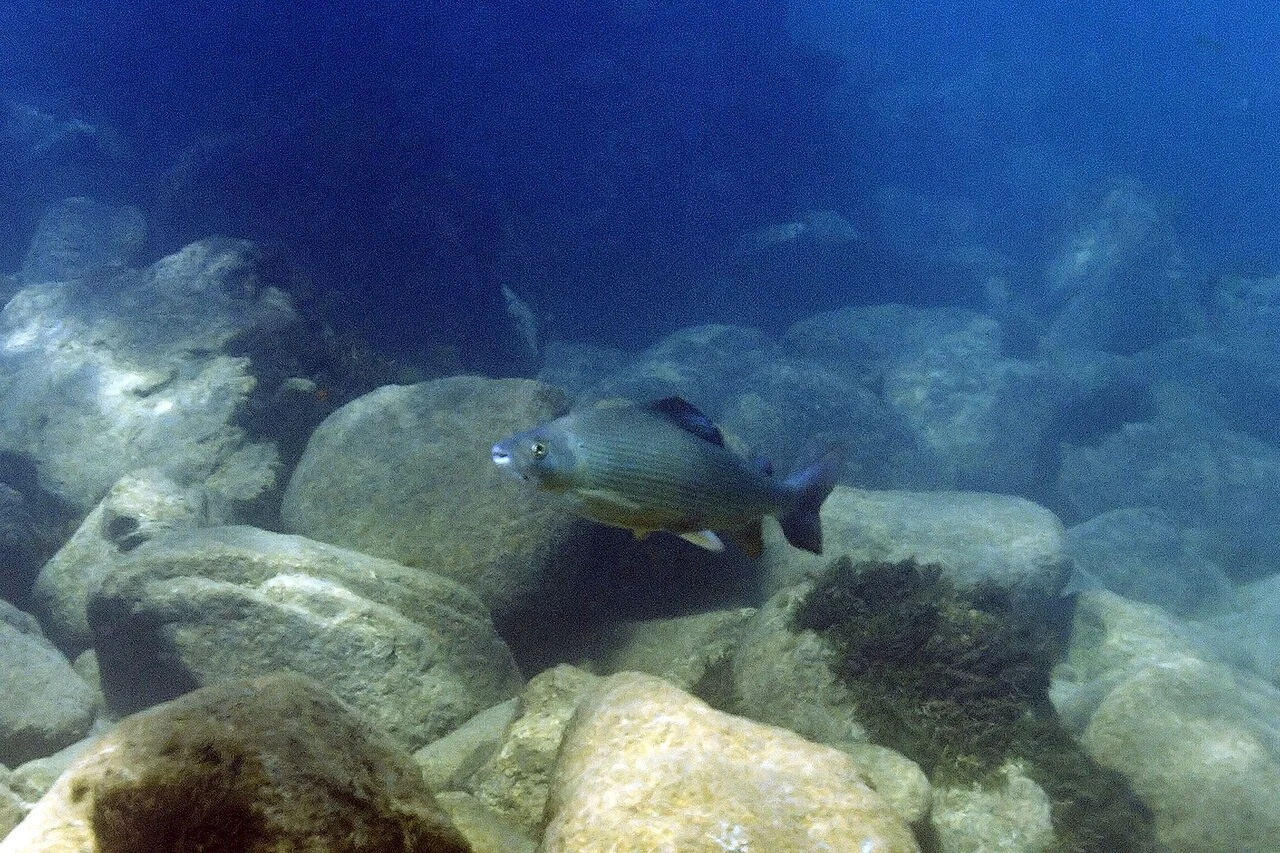
European grayling, Thymallus thymallus, are the tall-dorsal-finned fish shown in the representative cover photograph. Their diet changes from plankton in very small fry to bottom invertebrates, surface insects and sometimes fish. In a river, watch whether feeding happens below the surface or in repeated rises. A dry fly and a nymph solve different problems.
Use a 9-foot, 4–5-weight fly rod with floating line and a 2.7–3.6 metre leader. Finish with roughly 0.16–0.20 mm tippet, commonly around 4–6 lb depending on brand. Tie one size 12–16 nymph on a barbless hook, with weight incorporated into the pattern only where permitted. This single-fly starting rig is easier to track than a complicated multi-fly arrangement.
Stand downstream of the chosen seam, make a short upstream cast and lift spare line away from faster water. Follow the drift without towing the fly. Watch the leader or a locally permitted indicator for an interruption, then tighten with a smooth lift. A fly catching the same stone on every pass needs a shallower drift, lighter pattern or better angle, not a harder hook-set.
When fish rise regularly, change to a size 14–18 dry fly resembling the visible insects. Cast above the rise and allow the leader to straighten gently. Let the fish take before lifting; an immediate snap often pulls the fly away. If no fish rise, give a nymph a fair controlled trial before treating the surface as the main feeding layer.
Hossanjoki is closed to fishing from September 1 through May 31 in the current area guidance. This river lesson is therefore an open-season plan, not a November invitation. For an available lake alternative, check the current map and conditions rather than assuming the river closure applies identically to all lakes.
At Umpi-Valkeainen, ten-spined sticklebacks are documented prey for perch and trout. A small slim minnow imitation is a reasonable tactical response. Approach quietly, fan short casts first and compare two countdowns. Fish stocking does not make these clear-water fish unselective. If a fly or lure follows a visible fish without interest, stop repeatedly casting over it and change the approach or depth.
Norway: learn vertical control on a guided cod trip
Lofoten and other northern coastal bases offer sea trips, including the winter migration of skrei. January–April is a broad planning period for that migration, not an assured daily catch window. Atlantic cod, Gadus morhua, includes coastal stocks as well as the migratory fish called skrei. Those are not separate species, and color alone cannot reliably assign a fish to a stock.
Coastal cod can occupy kelp habitat, fjords and much deeper water. Larger cod eat fish and invertebrates; prey availability can draw them above the seabed as well as along it. Have the skipper explain the depth, bottom type and fish marks before lowering tackle. An abrupt reef edge and a level sandy patch call for different snag management.
For a modest guided drift, a 1.8–2.1 metre boat rod rated for the intended lure, a suitable conventional reel or robust 5000–6000 spinning reel, and roughly 30 lb braid are practical starting equipment. Add 1–2 metres of 40–60 lb abrasion-resistant leader. Tie to a rated swivel or solid ring and connect one 100–200 g pilker with a sound hook and split ring. The skipper may need lighter or heavier gear; the outfit must be matched, including rod rating and connections.
Lower under control until the lure touches bottom, then reel up one or two turns. Lift the rod smoothly and follow the lure down with contact. Long slack drops conceal bites and wrap hooks around line. A steady pull or weight on the lift deserves a firm tightening motion; keep the rod loaded and avoid pumping so high that the line goes slack on the return.
If the line angles far away, retrieve and reset rather than dragging the lure across unseen rocks. A lighter-drifting location can be a better answer than continually adding weight. If sounder marks are above bottom, retrieve through that layer instead of ignoring them.
A 12–18 cm soft shad on a suitable heavy jig head is an alternative to the pilker. Lower it to the chosen level and wind slowly with brief pauses. It can provide movement without aggressive rod lifts. For bait fishing, let the skipper supply the locally appropriate hook-and-sinker rig and demonstrate its bite response; do not attach extra hooks to a rig simply because deck space is available.
A worked session and the next adjustment
For a summer lake lesson, begin with the perch outfit and a 5 g jig. Spend ten minutes locating safe access, the outside weed line and a nearby rocky change. Fish the near edge with short casts, then search farther out with two different countdowns. Repeat the depth and direction of any bite. After fifteen to twenty minutes without contact, move to the second feature before changing multiple lure variables.
For a permitted grayling day, replace that search with three controlled lanes: near margin, main seam, pool entrance. For cod, the equivalent is a short drift across the feature followed by a reset that changes starting position or working depth. In all three cases, record what the lure or fly actually did. A result is more useful when you know how to reproduce it.
Rules checked November 1, 2026: Sweden's right of public access does not itself grant fishing rights. Finland's fisheries management fee has age exemptions and does not replace all local permits. Follow Hossa's mapped restrictions. Norway's Directorate of Fisheries lists protected areas and species, including Oslofjord cod; its current export arrangements differ from merely catching fish. Use the official links below for your dates.
Keep cold-water and sea trips within the guide's weather limits, wear flotation and have landing tools ready. Use wet hands and a suitable net, keep release handling brief, and avoid fishing for heat-stressed salmonids. These habits support the real objective: a repeatable presentation in suitable water.