
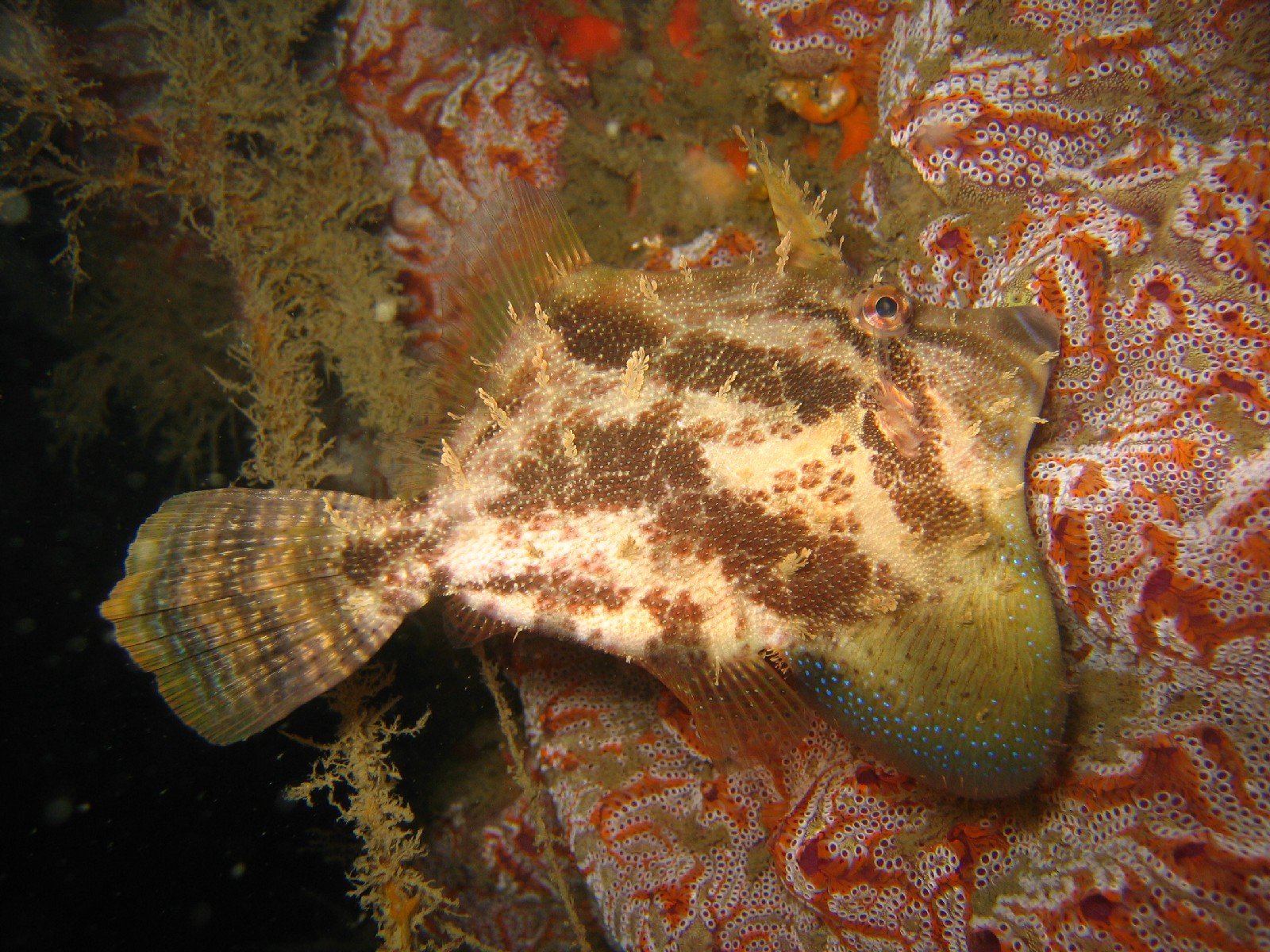
A leatherjacket can remove a surprisingly neat piece of bait while the angler waits for a dramatic bite. The answer is usually a smaller offering, a readable line and a hook positioned where the fish is actually nibbling. Heavy tackle and a large bait often make that harder.
Fanbelly leatherjackets occur in Port Hacking, but they are one of several local leatherjackets. This guide pairs identification with a practical shore search around permitted structure and weed edges. It uses Gunnamatta Bay's public facilities as access examples, not as a claim of a current concentration of fish. Tackle dimensions and session timings are starting suggestions.
Identify the fanbelly rather than guessing from colour
The fanbelly leatherjacket is Monacanthus chinensis, also called the fan-bellied or fantail leatherjacket. Look for the substantial skin flap under the belly, a concave snout profile, the triangular outline of the back and a filament extending from the upper part of the tail. Its mottled cream-to-brown colouring can change, so colour alone is unreliable.
Leatherjackets have a small mouth with beak-like teeth, rough skin and a prominent first dorsal spine. Similar-looking leatherjacket species need their own identification; a “leatherjacket” label does not establish that the fish is a fanbelly. Do not confuse them with puffers or assume any small fish with unusual skin is suitable to retain.
The species occurs widely in tropical and temperate Australian waters, including coastal New South Wales. Museum-backed records include Port Hacking. It uses reefs, estuaries and weedy habitat, and its food includes plant material and small invertebrates such as shrimp-like crustaceans and worms.
That varied diet helps explain why a small bait beside attached growth is a logical experiment. It does not mean that every fish beneath a jetty is feeding on bait or that bait must be collected from the adjacent shore. Bring legally sourced bait rather than disturbing the habitat you intend to fish.
Access: use the public facility, respect its other users
Gunnamatta Park on Nicholson Parade is identified in the local visitor fishing guide as a shore option outside the baths' nets. The nearby Cronulla boat ramp and jetty at 3 Tonkin Street are described by Sutherland Shire Council as supporting fishing as well as small-craft access.
These are shared facilities. Keep hooks and line clear of swimmers, divers, boats and people using the accessible jetty. A vessel loading or unloading has a practical claim on the space it needs; reel in and move rather than stretching a line across its approach. Obey current signs and any temporary closure.
Council warns that the Tonkin Street ramp is very shallow at low tide. For a shore angler, that is also a reminder that the water beside a convenient structure may be too shallow to fish effectively at some stages. Inspect the actual depth and do not assume that a jetty always reaches a deep channel.
Port Hacking's documented leatherjacket habitat includes weed and algae environments elsewhere in the estuary. Those records support a regional search, not a promise at each public access point. Shiprock is a scientific observation location for fanbelly leatherjackets, but it is a protected aquatic reserve, not a suggested fishing spot. Check the reserve boundaries before exploring other parts of the waterway.
Read a small piece of water carefully
Start with the outside of the structure rather than dropping directly into the thickest growth. Look for a clear vertical lane beside a pylon, a sand gap next to weed, or a depth change that can be reached without casting across moorings. The useful combination is food-bearing structure plus enough clearance to present and recover the hook.
If the water is clear, watch from a quiet position before lowering the bait. Fish may be visible, but seeing a small fish is not sufficient for species identification. Observe whether it stays near the growth, moves onto the sand or rises to investigate suspended food.
Try a bait just above the bottom first, then progressively higher if the lower position produces only weed or snagging. A leatherjacket's feeding position matters more than an arbitrary promise that they always feed on the bed. On a gentle tide, you can compare two depths on the same lane without changing the entire outfit.
There is no established November–December peak asserted here. Summer offers useful daylight for observation, but crowding, water clarity and current can determine whether a particular shore position is fishable. Choose a manageable period rather than a purported universal moon or colour formula.
Tackle for small bites and sharp teeth
A 6–7 foot light spinning rod and a 2000–2500 reel make close work manageable. Start with 6–10 lb mono, or fine braid with roughly a metre of mono leader. Mono gives some stretch and is straightforward for a short, lightly weighted rig; braid can improve contact but also transmits every abrupt movement.
Use approximately 12–20 lb mono for the short terminal trace, inspecting it frequently. Leatherjacket teeth can cut line; increasing breaking strain does not make mono bite-proof. A longer-shank size 10–6 hook is a useful starting range for a very small piece of prawn or squid. Check that its actual gape and strength suit the fish, because sizes vary between patterns.
Do not add a large wire trace automatically. It changes a delicate presentation and may not solve a fish biting above the hook. First reduce bait size, keep the hook exposed and shorten the snood. If repeated clean cuts continue, move position or stop targeting that group rather than leaving a succession of hooks in the water.
Have a landing net and pliers ready. Keep fingers away from the mouth and dorsal spine. Small hooks do not justify lifting a fish by the line onto concrete.
Rig one: a single short paternoster
Tie a small swivel to the main line and add a terminal rig body of about 50–70 cm of 15–20 lb mono. At the lower end attach a 7–15 g sinker, within the rod rating. Tie a short side dropper roughly 20–30 cm above it and connect the hook on a 10–15 cm snood.
The short snood reduces tangling and keeps the bite close to the point of tension. Lower the lead gently rather than making a forceful cast. Once it touches the bottom, wind up slightly so the bait sits clear of sediment and loose weed. If the sinker hangs in growth, move to a clearer lane.
Cut a piece of squid or peeled prawn about the size of a small fingernail or smaller. Thread it once or twice onto the hook so the point remains exposed and there is little loose material beyond the bend. A long strip lets a fish bite the end without contacting the hook.
Hold the rod with the line lightly tensioned. When you feel repeated nips, resist the urge to jerk at the first vibration. As contact develops into weight, lift smoothly and wind. If every lift returns an empty hook, shorten the bait and inspect whether it was sliding off rather than being eaten.
Do not jig the sinker aggressively. Begin with a nearly still bait, then try a small lift and pause of a few seconds. The movement is intended to make the offering noticeable, not to drag a heavy weight across the habitat.
Rig two: suspend the bait with a float
A float is helpful where weed or rough bottom makes the paternoster inconvenient and the current is gentle enough to control. Fit a 2–4 g pencil or small slider float on the main line. With a slider, place a stop knot and bead above it, then shot below it and a small swivel above a 25–40 cm hooklength.
Plumb the depth without repeatedly snagging. Start with the bait about 20–40 cm above the obstruction, adjusting the stop knot as needed. Balance the float so only a readable tip remains above water. Too much buoyancy can make a gentle nip hard to see.
Cast only far enough to reach a clear lane, then manage slack so the float drifts naturally. Do not hold it so tightly that the bait rises toward the surface. A slow, sustained dip or sideways movement is a reason for a short lift; repeated dipping in the same wave pattern is not necessarily a bite.
If the float travels rapidly into a mooring or net, retrieve early and choose a shorter line or a different position. Adding more shot does not grant control over a fundamentally unsuitable drift.
Bait and artificial alternatives
Prawn offers a soft, compact invertebrate presentation; squid stays attached more firmly. Compare them on the same rig and depth before declaring one superior. If tiny fish remove prawn immediately, a very small squid piece may make the experiment easier to read.
A 2–3 cm soft invertebrate imitation on a light jighead can be tried in a clear lane, but the beak-like bite may damage it quickly. Keep the lure small, lower it to the selected depth and use tiny lifts with long pauses. This is an optional experiment, not a demonstrated local replacement for bait.
A muted translucent or brown imitation is a sensible initial comparison with natural prey. A brighter body may make it easier for the angler to observe in clear water, but visibility to you is not proof of greater attraction to the fish. Solve size, hook exposure and depth before concentrating on colour.
| Situation | Rig to try | How to fish it | Adjustment after failure |
|---|---|---|---|
| Clear vertical lane beside structure | Short paternoster | Hold bait just above bottom | Lift the fishing depth if weed returns |
| Weed below, gentle surface flow | Small float | Suspend bait above the growth | Shorten drift before it reaches obstructions |
| Repeated nips without a hookup | Same rig with smaller bait | Leave point and gape exposed | Shorten snood, then compare firmer bait |
| Repeated cut traces | Pause and inspect | Replace damaged line | Move rather than lose more tackle |
A worked close-range session
At a confirmed open Gunnamatta position, begin with a 7 foot light rod, 8 lb mono and a short 15 lb terminal rig. Use a size 8 long-shank hook and a 10 g lead only if that weight is needed. Lower a small prawn piece into a clear lane outside the structure and fish it just above the bottom.
After several minutes, retrieve to inspect the bait and line. If the bait is untouched, raise it by about half a metre and compare. If it is stripped, reduce its size or change to squid at the original depth. Keep a note of which variable changed.
If the bottom rig repeatedly catches loose weed, switch to the plumbed float. If no contact follows at two controlled depths and a second accessible position, move on. This is a methodical search, not a promise that a jetty visit will produce fanbellies.
Local rules and care
Check NSW DPIRD's current rules, pay the recreational fishing fee unless exempt, and carry the required evidence. The current leatherjacket table lists no minimum size and a combined limit of 20; that is a ceiling, not a target. Gunnamatta Bay has a year-round prohibition on taking worms, nippers and shellfish within the defined area, so bring lawful bait. Check Port Hacking closures and aquatic-reserve boundaries before fishing.
Stay clear of swimmers and launching craft, use stable footwear and avoid slippery edges. Handle fish briefly with wet support, keeping clear of teeth and the locking spine. Release uncertain identifications promptly and remove all line and bait waste. A short session that leaves both the facility and the fish in good condition is a useful result.