
Choose a fishery you can learn in one trip
South America offers three very different first sessions: a trout drift in Argentine Patagonia, a lure cast for golden dorado on the Paraná, or a boat session for peacock bass in the Brazilian Amazon. Choose one base and spend enough time there to understand its water. A clear mountain river, a powerful floodplain channel and a warm forest lagoon need different tackle and different ideas about where a fish can intercept food.
Junín de los Andes is a practical base for the Chimehuín in Neuquén. La Paz and Santa Elena are established fishing destinations on the Entre Ríos side of the Paraná. Barcelos, on the Rio Negro in Amazonas, is a gateway to guided peacock-bass fishing. These are verified destination examples, not promises of unrestricted bank access: arrange the particular river reach, launch or community access before travelling.
The tackle sizes, depths and trial sequences below are practical starting suggestions. They are not local catch statistics, legal allowances or guaranteed bite windows. Let actual current, water level, observed prey and the permitted fishing method determine the final setup.
Know which fish you are targeting
Patagonian trout include introduced rainbow trout, Oncorhynchus mykiss, and brown trout, Salmo trutta. A rainbow usually has spotting on its tail and a pinkish lateral band; a brown often has red and dark flank spots and a less heavily spotted tail. Colour varies, so use several features. These are cold-water salmonids, not native South American river fish.
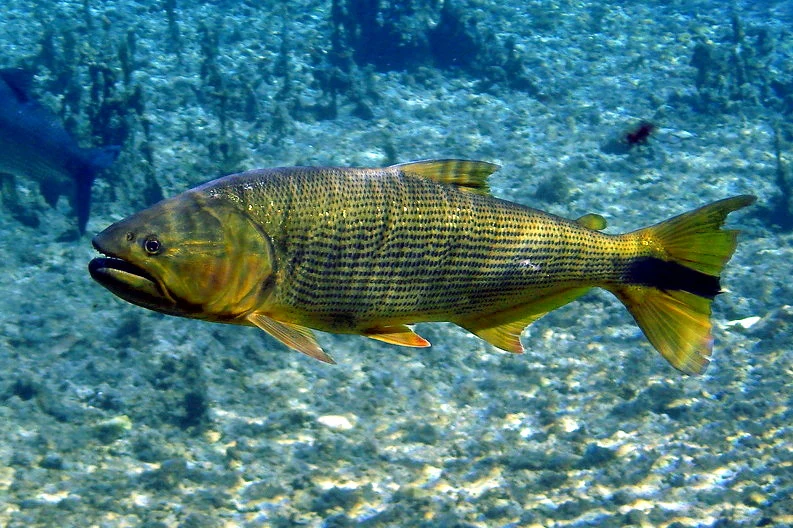
Golden dorado here means Salminus brasiliensis, the toothed freshwater predator, not the marine dolphinfish also called dorado. Its prey includes other river fishes. Bozza and Hahn's 2010 study of upper-Paraná predators, including this species, found fish in juvenile as well as adult diets and differences in prey size with predator size. That supports matching the forage you actually see; it does not establish one universal baitfish size for the lower river.
Around Barcelos the flagship target is tucunaré-açu, Cichla temensis, also called speckled peacock bass. Peacock bass are cichlids, not North American black bass, and other Cichla species share Amazonian waters. Have the guide confirm the identification rather than treating every patterned peacock as an açu. Aguiar-Santos and colleagues' middle-Negro research found larger prey in larger fish and feeding differences between the Aracá and Demeni rivers. A productive lure in one tributary is therefore a starting point, not proof that every fish elsewhere wants the same prey.
Read the structure before selecting a lure
| Water and condition | Likely target in this example | Food or holding reason | Method or lure | Presentation to try | Main caveat |
|---|---|---|---|---|---|
| Chimehuín riffle entering a deeper run | Rainbow or brown trout | Drifting insects pass a slower resting lane | Single nymph on a fly leader | Cast upstream of the seam and follow a natural drift | Weight, hooks and permitted methods depend on the exact zone |
| Chimehuín undercut or shaded bank | Trout where depth and cover coincide | Concealment close to an insect delivery lane | Dry fly or small streamer | Short accurate cast parallel to the edge | A bank without depth or food need not hold a fish |
| Paraná island point or current seam near La Paz | Golden dorado | Baitfish pass a boundary between fast and slower water | Shallow minnow or streamer | Work across the seam with controlled tension | Strong flow may sweep a light lure above the useful layer |
| Paraná woody edge with an adjacent channel | Golden dorado where present | Cover and an ambush route beside moving prey | Floating diving minnow | Cast beside wood and retrieve along its outside face | Repeated bottom contact is a snag warning, not a requirement |
| Rio Negro lagoon edge or submerged wood | Peacock bass | Concealment close to small fish | Surface plug followed by a subsurface minnow | Cover the edge, then test beneath it | Flooded forest can spread fish far beyond the visible shoreline |
| Rio Negro lagoon exit or connecting channel | Peacock bass where bait is present | Moving water may concentrate prey | Bucktail jig or sinking minnow | Fan casts across the mouth at different countdowns | Local level and current matter more than a calendar label |
A riffle delivers food; a pool provides depth and slower water. An eddy returns water behind an obstruction, whereas a seam separates different current speeds. Fish the useful boundary rather than assuming the whole quiet patch is equally productive. On broad rivers, a tributary mouth is interesting when it supplies forage or a favourable water difference, but muddy inflow can also make it less productive.
Patagonia: build a controlled trout drift
For a first fly session, start with a 9 ft, 5- or 6-weight rod, matching floating line and a tapered leader about 2.7–3.6 m long ending in roughly 4–6 lb tippet. Use stronger tippet when fish size, wind or snags demand it. Attach one size 12–16 nymph, with a modest bead only where the rules permit that pattern. Join the tapered leader to the fly line, add tippet with a suitable joining knot, and tie the fly directly to the tippet. Check every knot under steady tension. This fly-led plan uses artificial imitations rather than natural bait; do not assume bait is permitted in a trout zone.
Choose a fly that resembles the size and outline of the insects in the drift: a slim mayfly-style nymph and a somewhat fuller caddis-style pattern cover different shapes. Rainbow trout feed on aquatic and terrestrial insects, with fish and other foods becoming important in some settings; that general biology does not predict a particular Chimehuín hatch on your date.
Start with the nearest shallow seam before stepping into the river. Cast about 30–45 degrees upstream, allow the fly time to descend, and lift excess line off conflicting currents. Follow the drift without dragging the fly unnaturally across the seam. Watch the leader tip or a permitted indicator for a pause, sideways movement or unexpected acceleration; lift promptly and smoothly. Constant bed contact means the fly is too heavy, too deep or following the wrong lane. No contact and no response can justify a slightly heavier fly or a cast farther upstream.
If trout rise repeatedly, replace the nymph with a single size 12–16 dry fly matched approximately to the insects. Present upstream of the rise and let the current deliver it. A size 6–10 streamer on 6–10 lb tippet offers a different search method where allowed: cast across and slightly downstream, let it swing, then add short strips and pauses. Natural olive, brown or dark silhouettes are reasonable first comparisons; matching size, depth and drift usually deserves attention before buying more colours.
Neuquén announced the 2026–27 season opening for 1 November 2026. Opening day is not a promise of low water: spring rain and snowmelt can alter depth and clarity. Choose manageable seams and shallower margins when the main flow is high. In hot conditions seek cool, oxygenated water and stop targeting trout when they appear stressed.
Paraná: make the lure swim through the interception lane
A medium-heavy 2.1–2.4 m spinning or casting rod, a suitably matched reel, and 30–40 lb braid provide a useful starting outfit for moderate dorado fishing. Connect about 1–1.5 m of 30–50 lb abrasion leader, then a 20–30 cm, roughly 30–50 lb wire bite trace. Use knots or crimps intended for that wire and a strong, reliable lure connection. Fluorocarbon alone is not a dependable answer to dorado teeth.
Begin with a 9–13 cm floating diving minnow or a 15–30 g spoon that the rod can cast comfortably. Position the boat so a cast reaches the current boundary without dropping into the wood. Cast across or a little upstream, take up slack and let the lure work through the seam. Retrieve fast enough for positive action, not so fast that it rolls or skips. At a floating-minnow pause, its rise can help clear shallow cover.
If there are follows but no takes, shorten the next retrieve's bursts or try a smaller profile before changing location. If the lure never reaches the holding layer, use a deeper-running model or add countdown with a sinking lure. After repeated snags, shorten the cast, approach from another angle or run shallower; simply fitting heavier tackle does not fix a poor track.
A fly alternative is an 8- or 9-weight outfit with a short stout leader, wire bite section and a 10–15 cm baitfish streamer on a strong size 1/0–3/0 hook. Strip with the rod pointing toward the fly and tighten firmly with the line hand when the fish takes, then use the rod to cushion the fight. With conventional lures, reel out slack and make a controlled sideways sweep. Keep pressure through jumps without high-sticking the rod.
Rio Negro: search the surface, then the layer underneath
For an introductory peacock-bass session, a medium-heavy or heavy rod around 1.8–2.1 m, a strong casting reel, 40–50 lb braid and 1–1.5 m of 40–60 lb abrasion leader are useful starting choices. Increase capability when the guide expects exceptionally large fish or dense timber. Tie the leader to the braid with a well-practised connection and attach the lure with a strong knot or appropriately rated clip. Check damaged leader after every contact with timber.
Try a 10–14 cm walking bait or modest propeller plug near cover. Cast beyond the useful edge without landing inside branches. Take up slack, point the rod low, and use rhythmic twitches for a walking action or short pulls for a propeller lure. Pause briefly beside cover. Do not strike at the splash: tighten when the fish's weight loads the line.
If surface attention does not become solid takes, change the layer. A 10–13 cm suspending minnow can be twitched just under the surface; a 10–20 g bucktail jig with a strong size 2/0–4/0 hook can probe a deeper edge. Cast alongside the wood, allow a short counted descent, then use short lifts and a controlled fall. Begin shallower than the presumed snag depth and extend the countdown gradually. Slack appearing before the expected bottom contact may be a fish lifting the jig: reel tight and sweep.
Start with a baitfish-like silver or pale flank in clear water and compare a darker silhouette when contrast is poor. Bright colours are an experiment, not a rule for all blackwater. The regional tourism season commonly spans September to February, but rising water can spread prey into flooded habitat, and extreme low water can restrict access. Ask about the actual tributary level and recent change, not just whether the month is advertised as good.
A worked first session
For a Paraná morning, agree on three accessible seams with the guide. Spend the first few minutes watching bait movement and judging the lure's swimming depth beside the boat. Fish the closest lane first, then the outside seam, using a 10 cm floating minnow on the wire-trace outfit. Give each lane several accurate casts from useful angles rather than repeatedly casting at the same unproductive point.
If there is no contact after roughly 15–20 minutes, test one deeper-running lure on the same structure. If fish follow, try a smaller profile or a longer pause. If nothing responds, move to a different type of structure, such as a channel edge instead of another identical bank. Record water clarity, lure depth and the successful cast direction. Early light can help a presentation, but shade, flow and prey can keep a worthwhile lane productive later.
Apply the same sequence elsewhere: observe, fish the nearest useful water, vary depth, then move. Avoid changing size, colour, speed and location simultaneously; otherwise a bite teaches very little about the cause.
Local rules and brief handling notes
Check the current Patagonian regulations and Chimehuín zone before choosing hooks or methods; the mouth has special conditions. Entre Ríos Law 11.174 allows sport dorado fishing with mandatory release, subject to permits and current restrictions. In Brazil obtain the applicable amateur fishing registration and check local access; Barcelos authorities reaffirmed a zero-retention rule for tucunaré in March 2026. These sources do not establish that every reach is open on your travel date.
Use an experienced boat operator for major rivers, wear flotation, and do not wade unfamiliar current. Keep released fish supported and wet, remove hooks with suitable tools, and keep hands clear of dorado teeth. A short, controlled landing is more useful than an extended photograph session.