Winter king mackerel fishing off southeast Florida is a search for feeding fish, followed by a presentation problem: put a lively bait or correctly swimming lure at the depth of the action. Trolling a random reef with every line on the surface leaves too much to chance. Start by finding forage, compare two presentation depths, and repeat the direction and speed that produce strikes.
The rig dimensions, speeds, distances and example depths below are editorial starting suggestions, not measured catch forecasts or universal settings. Adapt them to bait size, current, boat handling and the equipment’s instructions. Slow-trolling keeps live bait moving through the search area, while a downrigger lets you compare a deeper presentation with the surface baits.
Know the fish and the winter setting
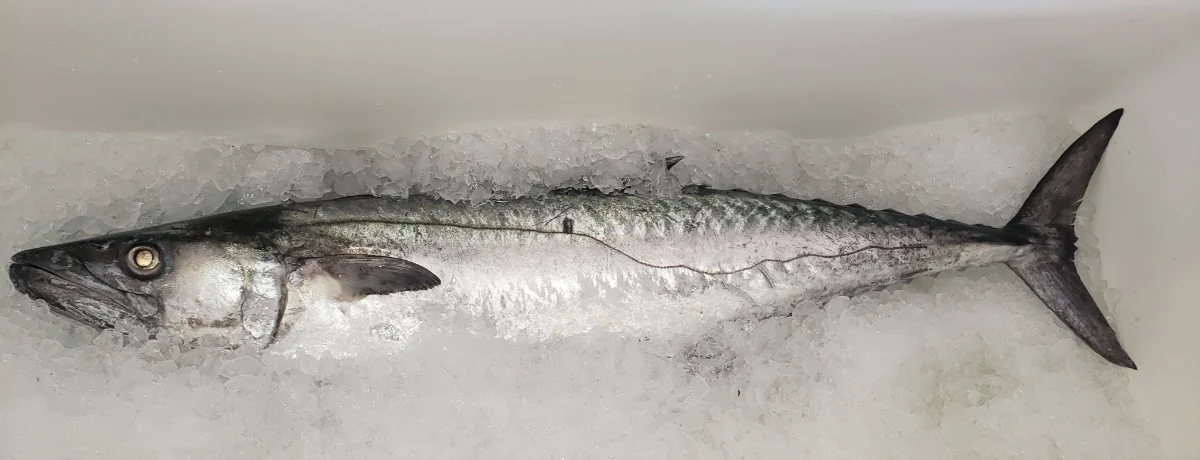
King mackerel, Scomberomorus cavalla, have a sharply dropping lateral line below the second dorsal fin. Young kings can have spots, so spots alone do not establish Spanish mackerel, Scomberomorus maculatus. Check the lateral line and first dorsal fin: Spanish mackerel have a more gently sloping line and a dark patch at the front of that fin. Cero, Scomberomorus regalis, are another possible confusion.
Kings are mobile coastal predators, not bottom residents tied to one wreck. Their seasonal movements follow changes in temperature and food availability, generally southward in winter and northward in summer. That supports a winter search off Palm Beach, Broward and Miami-Dade, but does not establish a current bite at any particular inlet. A reef waypoint without bait is a place to investigate, not a reason to spend all morning.
Look for suspended bait beside reef ledges, wrecks and changes in current or water color. Kings can intercept forage above structure or outside a bait school. The useful question is not just “How deep is the bottom?” but “How deep is the food?” A hard bottom may help aggregate bait, while a sand stretch with a strong bait school can also deserve a pass.
Find a lane before putting out rods
Choose a manageable area from the chart and local reef information, then inspect it with sonar. As a starting search, compare a nearshore contour with the next deeper contour rather than committing to a fixed depth. If you begin over roughly 40–100 feet, treat that as an exploratory range, not the species’ depth limit or a promise of winter fish.
Idle across the contour and note the bottom’s highest point, bait depth and current direction. Mark the bait separately from the wreck. Surface birds may reveal forage, but also check below the surface activity. Fish the outside edge first instead of driving through the center repeatedly.
Compare the up-current face and the side where bait actually appears. Current can compress prey against a feature or carry it beyond it; do not assume every school sits on the same side. Troll parallel to the edge long enough for the baits to reach it. If the boat crosses a waypoint, the long bait may still be well short of it.
Avoid prescribing one perfect temperature or tide. After a front, compare water clarity, bait presence and the more sheltered workable contour. Moving current can help define an edge, but rough inlet conditions are not a fishing advantage worth forcing.
Choose bait by condition and profile
Live-bait options include pogies, herring, Spanish sardines, ballyhoo and mullet. Begin with healthy bait that resembles the forage you can see or identify. A roughly 5–8-inch bait is a useful manageable starting size; larger baits require correspondingly heavier hooks and a different towing pace. Bigger is not automatically better when kings are feeding on small prey.
Keep bait uncrowded in a circulating livewell and handle it gently with wet hands. A bait that repeatedly rolls, swims sideways or hangs limp needs replacement. Retrieve a suspect bait before changing the entire spread. A king may investigate it, but exhausted bait gives poor feedback about whether your presentation works.
If live bait is unavailable, choose a purpose-rigged dead ballyhoo or an artificial spread. Dead bait must tow straight: check it beside the boat before deployment. A commercial pre-rigged bait is a useful beginner option because alignment, hook placement and any chin weight must work together. A spinning ballyhoo twists line and should be re-rigged, not simply sent farther back.
Build a live-bait outfit and stinger rig
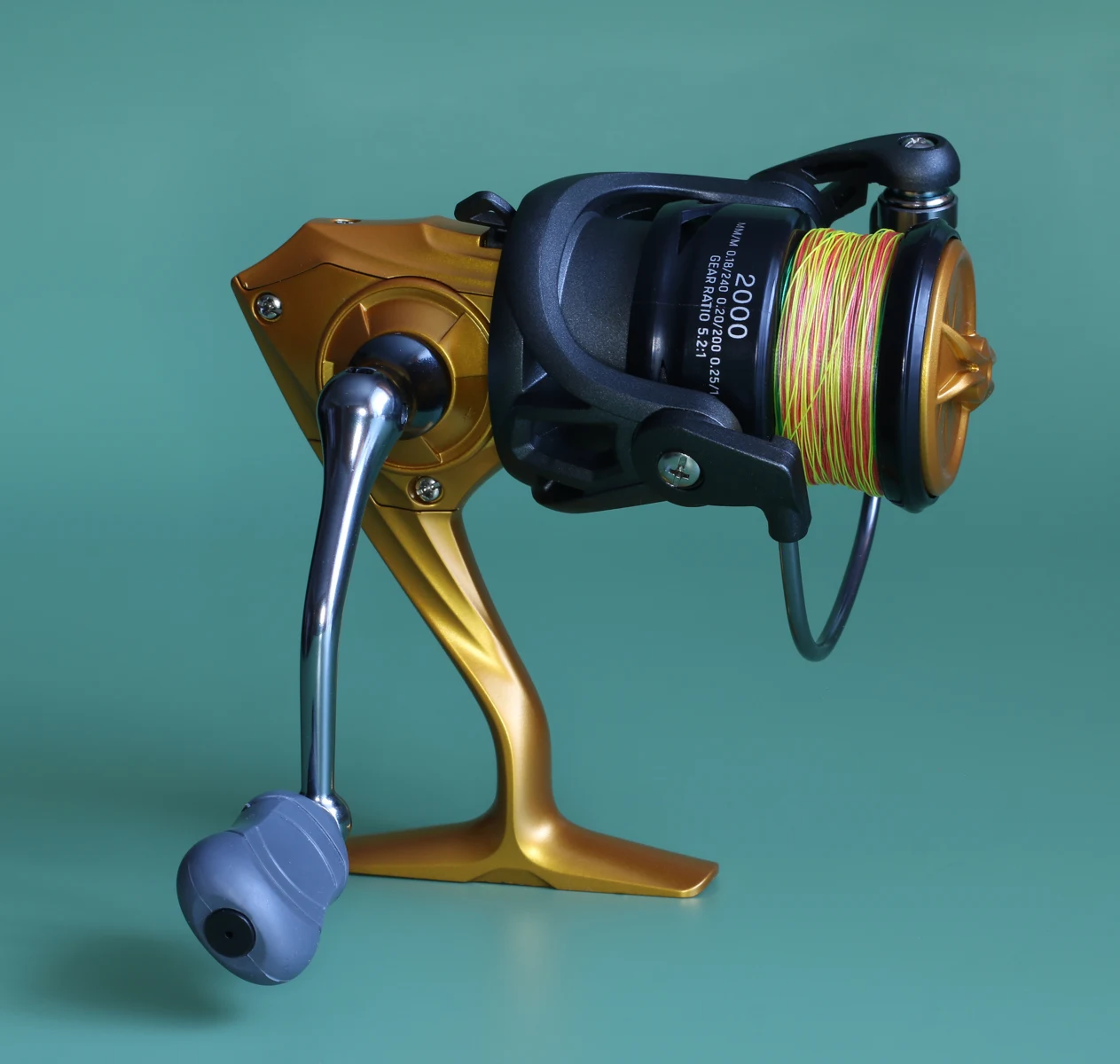
A 7-foot-class boat rod with a forgiving tip and a smooth-drag reel holding several hundred yards of 20–30-pound monofilament is a practical starting outfit. Braid can work, but its low stretch puts more responsibility on the rod and drag. Twenty-pound tackle is a useful starting point, with heavier equipment appropriate for larger kings.
For an example terminal rig, connect the main line to a small, strong swivel, then about 18–24 inches of fine single-strand wire. Approximately 30–45-pound wire is a reasonable starting range for modest live baits. Choose by actual diameter and bait action, not breaking strain alone. Wire resists teeth; ordinary fluorocarbon does not provide equivalent bite protection.
Attach a small live-bait nose hook to the wire, then a short wire extension carrying a small treble stinger. A 1/0–3/0 nose hook and No. 4–2 treble illustrate the scale for a medium bait; hook sizes vary substantially by brand. Use hooks strong enough for the drag but light enough that the bait swims freely.
Rig it in this order: - Make the swivel and hook connections with correctly formed haywire twists for single-strand wire, following the wire maker’s instructions. A mono knot is not a substitute. - Pass the nose hook across the firm nostril area, keeping the mouth and eyes clear. - Measure the stinger extension against the actual bait. It should reach near the rear portion without pulling the body into a curve. - Lightly pin one stinger point into the flank, clear of the backbone, leaving the other points exposed. Do not bury the whole treble or stretch the wire tight. - Lower the bait beside the boat. Reject a rig that makes it roll or bends it unnaturally.
A single-hook rig is a simpler alternative when smaller bait is taken whole or when reducing loose hooks is the priority. The stinger addresses short bites across the rear half; it also adds handling risk. Carry rigs in a holder and keep every spare hook away from feet and hands. Replace kinked wire and damaged hooks rather than straightening them indefinitely.
Slow-troll three lines with a purpose
Begin around 1–2 knots only if the bait swims naturally at that pace. Judge the bait through the water, not GPS speed alone: current changes speed over ground. If idle speed overpowers fragile bait, use a different workable direction or switch to a drift presentation rather than dragging it sideways.
For two anglers, start with three rods: - A shallow long bait about 70–100 feet behind the boat. - A shallow short bait about 30–50 feet back on the opposite side. - A downrigger bait presented above the marked forage, with approximately 15–25 feet between release and bait as an initial setup.
Those distances are adjustable separation tools, not special strike zones. Put out the long bait first, then the short bait, then the controlled-depth line. Keep rod positions distinct and use broad turns. On a turn the outside bait speeds up and the inside bait slows or sinks; a tight circle can ruin otherwise sensible spacing.
If bait is at 25 feet over a reef topping at 45 feet, initially compare a surface bait with one around 15–20 feet. Keep the downrigger weight clear of the structure and watch cable angle. The counter measures cable paid out, not guaranteed vertical depth. Follow the downrigger’s release and load instructions; do not add a heavy planer to an unsuitable light outfit.
Use a separate artificial-lure search spread
Artificial lures help cover water when bait is scarce or livewell time is limited. Do not mix a fast plug spread with delicate live baits and expect both to work.
Try two fish-shaped diving plugs about 4–6 inches long, selected for different running depths, or a plug and a correctly rigged trolling spoon. Start around 4–6 knots if the particular lures run cleanly there. Watch each beside the boat: plugs should track steadily without blowing out, and spoons should work without uncontrolled spinning. Follow the lure maker’s speed, connection and depth guidance.
Published diving depth is model-specific. For example, Rapala lists different X-Rap Magnum models for nominal 10-, 15- and 20-foot depths; that is not a guarantee that every similarly sized plug reaches them. Line diameter, setback and operating conditions affect presentation. Do not buy by color while ignoring depth.
Begin with a silver or blue/silver baitfish pattern in clear water, then compare one higher-contrast pattern if visibility is poor. These are test choices, not demonstrated local color rules. Keep the productive depth and speed constant while testing color or profile.
Adjust to the evidence
| What you observe | First adjustment | Why |
|---|---|---|
| Bait below every lure | Lower one presentation above the school | Tests depth before replacing all lures |
| Baitfish bitten through behind the hook | Check stinger reach and exposed points | Tests a short-strike problem |
| Live bait rolls or tires quickly | Correct rig alignment and reduce towing pressure | Restores natural movement |
| Plug skips or blows out | Check tracking and reduce speed within its instructions | Restores the intended action |
| Hits occur only in one direction | Repeat that heading outside the school | Current changes lure speed and approach |
| No bait and no strikes after two useful passes | Search another contour or feature | More time over empty water proves little |
When a king strikes a live bait, let the rod load and the drag work; avoid a violent overhead hookset with a small treble. Maintain steady pressure through the first run. A modest initial drag, around 3–5 pounds for the example tackle, can be checked with a scale and adjusted for hook strength. It is a starting suggestion, not a requirement to tighten the reel during a fast run.
Mark the strike immediately, continue forward under control, and clear interfering lines before turning. Repeat the track with an offset so the bait, not just the boat, passes through the productive water.
A worked morning
Suppose the sounder shows bait at 20–30 feet above a reef in 65 feet of water. These are hypothetical observations, not a current fishing report. Spend the first 15 minutes locating the school and choosing a safe trolling lane. Deploy the three-line live-bait spread, with the deep bait initially above the school.
Make a contour pass and then a comparable pass in the opposite direction. If only the deeper bait is struck, move one other presentation toward that zone while retaining a shallower comparison. If the bait is cut behind the hook, inspect the stinger before changing bait species. After roughly 30–45 minutes with good bait but no response, change one variable or investigate the next feature.
If you cannot find forage, switch to a two-plug search spread and cover a larger area. If you locate a tightly defined school but towing is awkward, drift a live bait along its outer edge with the same bite protection, controlling depth and avoiding other boats. Casting a metal jig beyond visible feeding activity and retrieving alongside it is another option; do not cast into birds or across trolling lines.
Landing and the brief rules check
Clear loose hooks before bringing a king alongside. Keep hands away from its teeth and use long pliers. Support a released fish horizontally, minimize air exposure and never gaff a fish intended for release. Ice retained fish promptly.
Checked 27 October 2026: FWC lists a 24-inch fork-length minimum, two fish per harvester daily in Atlantic state waters excluding Monroe County, and an open year-round season. Gulf state waters and Monroe County have a different bag limit. Check the official rules for your precise location, gear and trip before fishing; do not combine state and federal bag limits. Check the marine forecast and inlet conditions before departure.
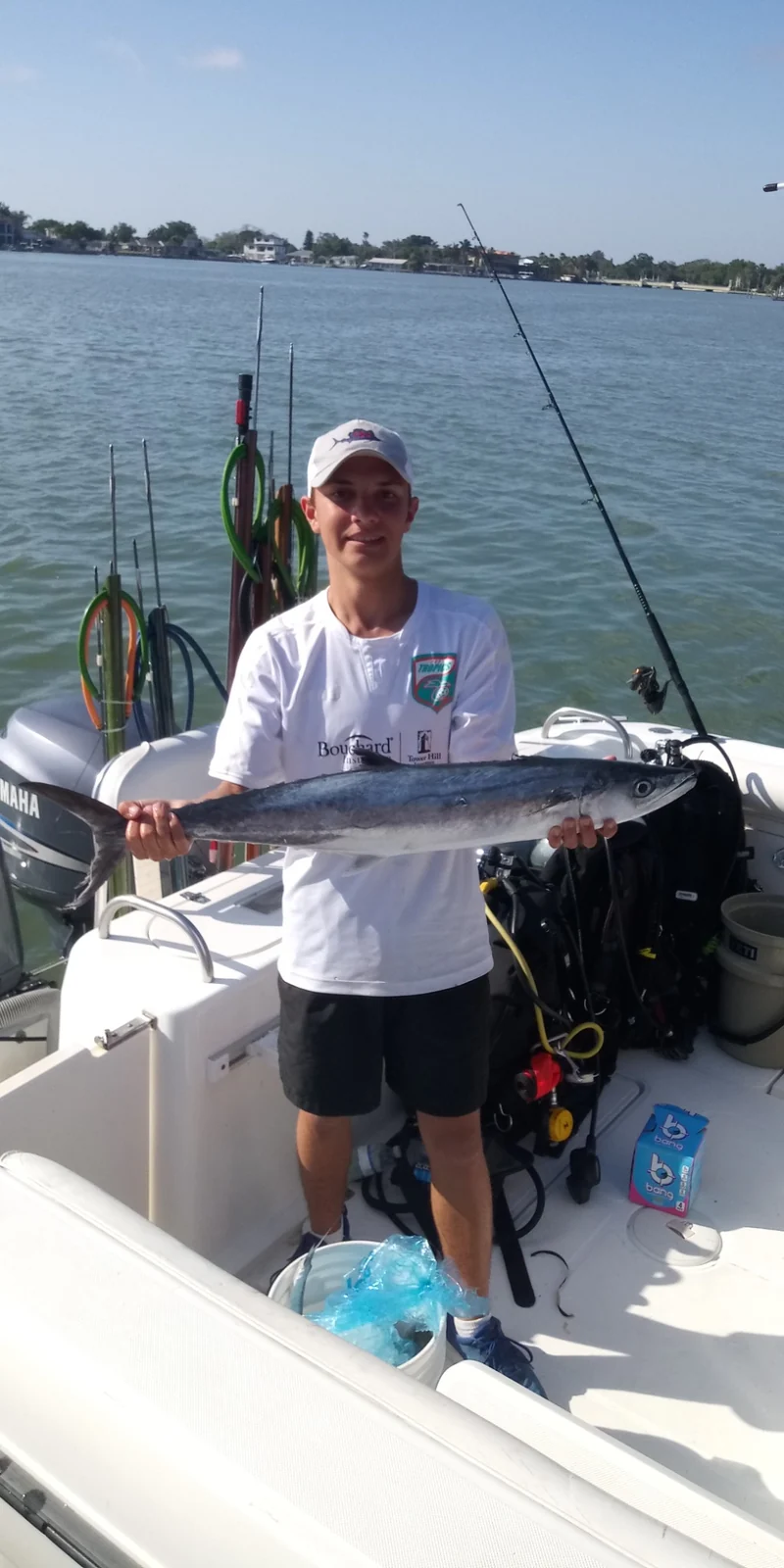
The cover is the owner’s personal king mackerel photograph. Catch location and date are unconfirmed; it does not document a southeast Florida winter catch.