
Southern Europe can mean fishing a Mediterranean sand-and-seagrass edge for bream, drifting a fly past an Alpine boulder, or working a soft lure down a Spanish reservoir slope. The useful first decision is which of those situations you want to learn. A rod and rig that solve one may be poorly suited to the others.
This guide uses three concrete examples: Croatia's Adriatic coast, the Avisio near Predazzo in Italy's Trentino, and the Mequinenza reservoir around Caspe and Chiprana in Aragón, Spain. They are separate trip choices, not a claim that the same fish or rules apply across the region. The numerical setups below are practical starting suggestions; local depth, current, access and permitted methods determine the final choice.
Croatia: put a bait beside feeding habitat
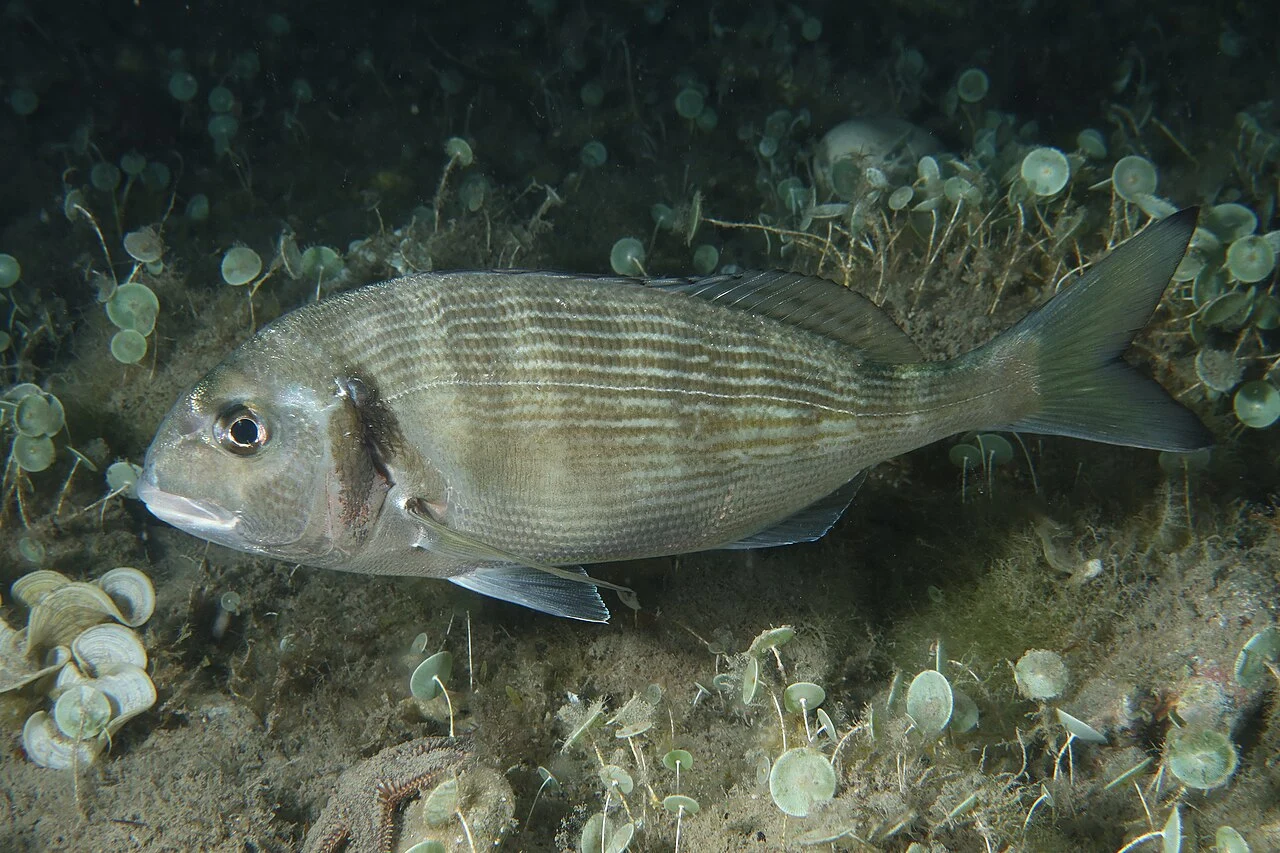
Gilthead bream, Sparus aurata, is a useful Mediterranean starting target. Look for the gold band between the eyes and dark marking near the gill cover rather than identifying every silver bream by body shape. Other seabream species can share the same water. European seabass and common dentex are different predators and should not be treated as interchangeable targets for a small bottom bait.
Gilthead bream use coastal sand, mixed rock and sand, seagrass habitat and brackish water. Their diet includes molluscs and crabs, which makes an unobstructed bottom bait near feeding ground more logical than randomly casting into the deepest available water. A bare sand pocket beside vegetation lets the bait remain visible while keeping the hook out of dense leaves.
The Neretva estuary and nearby Malostonski Bay illustrate this geography. Published research has documented juvenile gilthead bream in the estuary and feeding associated with shellfish in the bay. That is historical biological evidence, not a current catch forecast or a grant of access. Arrange an authorized shore position or a local guided outing, and stay clear of shellfish leases and restricted areas unless access is expressly allowed.
Start by finding a clean patch within reach, then identify the vegetation boundary, rock edge or change in slope adjoining it. In clear shallow water, a low-light session is a reasonable test for wary fish; in turbid or moving water, bait presentation may matter more than the clock. Seasonal use of brackish margins can change, so do not assume a summer observation predicts winter occupancy.
Assemble and fish a running ledger
A 3.0–3.6 m rod rated for approximately 20–80 g casting weight, a 4000–5000 spinning reel and 15–20 lb main line make a workable sheltered-shore starting outfit. Match the total sinker and bait weight to the rod. With braid, use an abrasion-resistant rubbing section before the terminal rig where stones can contact the line.
Thread a running sinker of roughly 15–40 g onto the terminal line, add a bead to protect the knot, then tie a small strong swivel. Attach 60–100 cm of 12–20 lb mono or fluorocarbon to the other eye and finish with a strong size 4–1 hook matched to the bait. The sinker should hold the bait near the chosen patch without burying or rolling continually; use more weight only if the rod and conditions justify it.
A legally obtained marine worm or small piece of mussel flesh is a practical bait option. Thread a worm in sections while leaving the hook point clear. Secure soft shellfish flesh with a little bait elastic around the flesh, not a thick wrapping over the point or gap. Match the offering to the hook: an enormous bait on a small hook produces missed bites rather than selective fishing.
Cast onto clean ground beside the habitat, not into the center of the grass. Let the sinker settle, wind in slack and rest the rod with enough sensitivity to see developing pulls. Small taps can be bait pickers; a sustained draw or line moving sideways deserves attention. With a conventional J-hook, reel down and make a controlled sweep when the fish has loaded the line. Do not repeatedly strike at every tremor.
If bait returns untouched, change the patch or distance after a deliberate test. If it is stripped quickly, reduce loose flesh, use a firmer permitted bait or move away from the small-fish concentration. Repeated grass or rock snags call for a different cast angle or cleaner landing zone before a heavier sinker.
Float fishing when the bottom rig will not stay clean
In a sheltered accessible position, a sliding float can keep bait just above vegetation. On the same general line strength, thread a stop knot, bead and 3–8 g sliding float onto the line; add enough shot below it to cock the float, then a small swivel and 40–70 cm hooklength to the baited hook. Start with the bait just off the bottom, using measured depth rather than an assumed universal setting.
Cast slightly up-current of the target and mend excess line so it does not drag the float unnaturally. Let the bait travel along the edge. Lift into a sustained submergence or purposeful sideways movement. Shorten depth if the rig repeatedly hangs up; lengthen it a little if the bait rides well above the feeding zone. Choose the ledger when you need to hold one clean patch, the float when a gentle drift can cover an edge.
Trentino: fish the seam, not just the scenery
The Avisio near Predazzo offers a specific starting area to investigate, including the river toward Moena and the Travignolo confluence area. Official destination guidance identifies accessible riverside routes, but the local fishery manager must confirm the exact permitted section, dates and methods.
Marble trout, Salmo marmoratus, have an irregular marbled pattern, including on the head; juvenile markings and hybridization with brown trout complicate identification. Brown trout are not simply small marble trout, and grayling is another separate species rather than a guaranteed companion in every reach.
Look for a boulder that creates a slower pocket beside a food-carrying current, the deeper outside edge of a pool, or a seam where fast and slow water meet. The fish can hold with less effort while intercepting drifting aquatic insects. Caddis and stonefly nymphs and mayflies are useful forage categories; larger trout may also respond to a fish imitation. Choose by observed feeding and water conditions rather than assuming every large trout needs a large lure.
A single-nymph setup and a dry-fly alternative
For moderate accessible water, start with a 9–10 ft, 4–5-weight fly rod, matching floating line and a 2.7–3.6 m leader ending in approximately 0.16–0.20 mm tippet. Use a stronger tippet where fish size and current require it. Tie on one barbless size 12–16 weighted nymph, with a roughly 2.5–3.5 mm bead as an initial range, subject to the section's rules. An adjustable indicator above the fly can help where permitted; set the distance to give the fly time to approach the feeding depth.
Begin close to the bank before wading. Cast a short distance upstream and across the seam, raise the rod to keep spare line out of the faster current, and follow the drift without pulling the fly. An indicator that hesitates, dips or moves differently from nearby bubbles warrants a smooth lift. Constant bottom contact means too much depth or weight; a fly racing high through a deep pocket may need an earlier upstream cast or a slightly heavier bead.
When fish rise consistently, switch to a size 12–18 dry fly resembling the insects you can actually see. Remove the nymph and indicator, extend the leader if presentation requires it, and cast upstream of the rise so the fly arrives before the line. Mend once if needed and allow a short drag-free drift. Lift when the fish has taken and turned down, not at the first splash.
If neither approach produces interest after covering the near seam, middle lane and deeper pocket, move to another holding feature. In higher water, a permitted 5–8 cm streamer on stronger tippet is an alternative: cast across and slightly downstream, let it swing through the softer margin, then retrieve with short strips and pauses. Do not interpret high water as permission to wade a dangerous channel.
Aragón: search reservoir depth with a fish imitation
Mequinenza, also known as the Mar de Aragón, offers reservoir fishing around Caspe and Chiprana. Regional tourism information identifies municipal launching facilities at Casa del Barquero in Chiprana and the Club Náutico area in Caspe. Check current launch operation, boating requirements and fishing permits; private launches have separate access conditions.
Zander or pikeperch, Sander lucioperca, is an introduced predator here, not a native Mediterranean seabass. Its elongated body and two dorsal fins distinguish it from a bream; confirm identification before deciding what may be released or retained. Adult zander are principally fish predators, but prey composition varies between waters. A slim small-fish imitation is a sensible starting tool without claiming one exact prey species dominates every reservoir bay.
Find a point, submerged slope or edge adjoining deeper water rather than treating an entire open reservoir as equal. As a search suggestion, begin around 3–8 m where you can control the lure, then use observed bait or sonar to test deeper water. Light, water clarity, temperature and oxygen can change usable depth; the deepest available water is not automatically best.
A 2.1–2.4 m spinning rod rated about 7–28 g, a 2500–4000 reel, 10–15 lb braid and 1–1.5 m of 12–20 lb leader are practical starting tackle. Thread an 8–12 cm soft shad straight onto a 7–14 g jighead with a strong hook sized to the body. A crooked lure twists and fishes poorly. Increase weight only enough to detect bottom or the required depth while remaining within the rod rating.
Cast across a manageable slope, count the controlled fall and note when the line slackens at bottom. Lift the lure 20–40 cm, then let it fall on a lightly controlled line. Watch for an unexpected stop, tap or sideways movement; reel down and sweep firmly into a convincing bite. If you snag every cast, retrieve uphill less steeply, shorten the drop or fish just above the bottom.
A drop-shot keeps the lure above a snaggy or silty bed. Tie a size 1–1/0 hook to the leader with a Palomar knot, leaving a 30–60 cm tag. Pass the tag back through the eye so the point faces upward, clip a 7–15 g sinker below, and nose-hook a straight 7–10 cm soft bait. Hold the weight in contact and make small rod-tip shakes with pauses; do not drag it continuously through rocks. Reel and lift smoothly when the rod loads.
Start with a silver or muted translucent fish pattern in clear water and compare a more conspicuous contrast in reduced visibility. This is a visibility experiment, not evidence that a particular color always catches zander.
Three worked sessions to choose between
| Session | First search | Forage or holding reason | First presentation | Adjustment |
|---|---|---|---|---|
| Sheltered Croatian shore | Clean sand beside vegetation | Bream can search the boundary for bottom prey | Running ledger with a small secure bait | Move the landing patch if fouled; try a float over cover |
| Open, permitted Avisio reach | Near-bank seam, then boulder pocket | Current delivers insects beside slower holding water | Short upstream nymph drift | Change depth before fly pattern; use a dry fly for sustained rises |
| Permitted Mequinenza outing | Accessible point and adjoining slope | Predator and prey can use a depth transition | Controlled jig fall and short lifts | Try a drop-shot for a precise station or move to another depth band |
For any of these half-days, spend the first ten minutes reading the water. Give the first method enough casts or drifts to compare angles, then change one variable: depth, speed, bait size or location. Record what changed. An hour repeating a snagging or visibly dragging presentation teaches less than a careful adjustment after five poor attempts.
Rules and handling that affect the plan
Croatia's fisheries authority requires the appropriate marine fishing authorization and applies additional restrictions to protected areas and certain gear. Trentino's provincial rules generally close flowing waters from 1 November through 31 January, with specified exceptions; do not plan an Avisio session during that closure, and check the manager's stricter dates and methods. Aragón's 2026 plan regulates invasive-species fishing by water and species: its zander annex includes Mequinenza, but release permissions are not universal. The applicable cyprinid-water bait rules prohibit fish and fish parts as bait, so use the artificial rigs described here.
Keep a landing net ready, wet hands before handling fish, and follow the local release or retention requirement. Stay off unstable shore edges, avoid damaging seagrass, and clean equipment between catchments. Choose a safe bank position before casting or entering current.