
Winter steelhead reward controlled presentations through a small amount of useful water. Find a lane where a fish can travel or rest without fighting the strongest current, then keep a jig, spoon or permitted bait in that lane long enough to be noticed. The plan below teaches that process from the bank; the tackle dimensions and trial durations are practical starting suggestions, not guaranteed prescriptions.
Current local-rules note, checked 31 October 2026: WDFW's 16 October notice closes the listed Hoh and Quillayute watershed waters to all fishing from 19 October until further notice, including the Bogachiel from its mouth to the Olympic National Park boundary. The emergency-rule index still lists this closure. The Bogachiel example below is therefore a plan for a confirmed future opening, not an invitation to fish now. Check the exact reach, current emergency rules and annual regulations before travel, including licence/catch-record requirements, retention, bait and hook restrictions. Park waters have separate rules. Do not infer reopening from rainfall or an older season table.
Know the fish and the coast
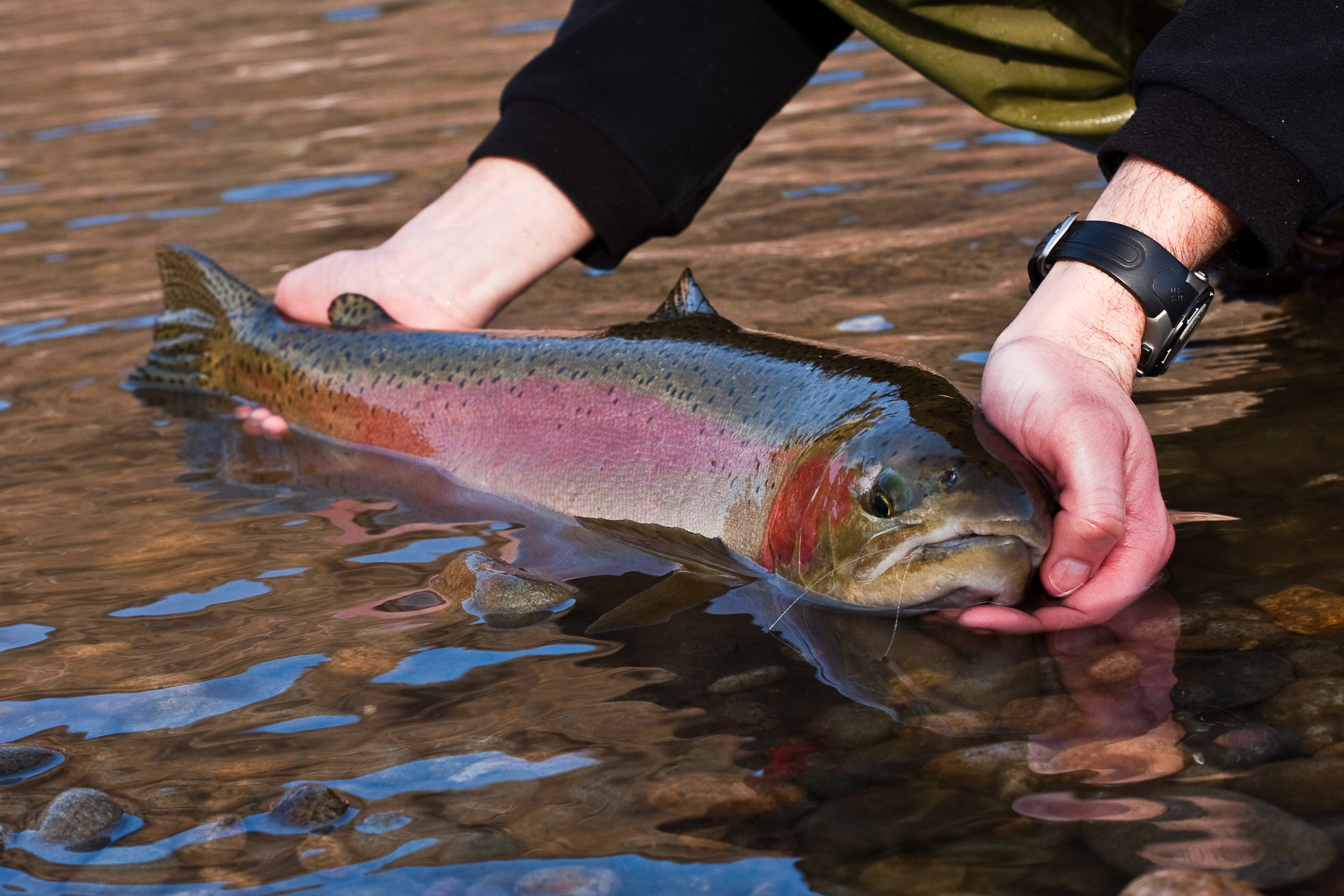
Steelhead are the sea-going form of rainbow trout, Oncorhynchus mykiss. A returning fish can be bright silver or develop a stronger pink lateral band; colour alone is unreliable. Look at the complete combination of spotting, fins, tail and mouth using an identification guide. Coastal cutthroat commonly show orange-red throat markings. Salmon can overlap in the same river, and a salmon encountered while steelhead fishing still falls under its own rules. A healed adipose-fin clip can be relevant to hatchery identification, but an uncertain mark is not permission to retain a fish.
The species is native to Pacific-draining waters of western North America and parts of Asia. Washington's coastal management area includes the Quillayute, Hoh, Queets, Chehalis and other west-side systems; these are distinct fisheries with different access and seasons. Winter-run fish enter freshwater close to spawning maturity. Local arrival, flow and water clarity matter more than a fixed calendar promise.
A specific access reference is WDFW's Anderson Homestead Wildlife Area Unit, approximately five miles south of Forks, reached from Furman Road off Highway 101. It provides foot access to the Bogachiel. Check the unit map and notices, remain within authorised access and respect the private neighbouring land. This identifies a real access point, not a guaranteed holding pool or a presently open fishery.
Read current, bottom and light together
Start from stable ground and inspect the near bank before casting farther. A useful first search is a walking-speed seam over gravel or cobble, adjacent to deeper water. In suitable conditions, test roughly 3–6 feet of water before trying deeper slots; that is a presentation starting range, not a depth requirement for the species. High water can move the useful lane against the bank. Low clear water often requires a quieter approach and more attention to depth and cover.
Pools offer security, but the deepest centre is not always the most practical target. The head brings concentrated flow; the shoulder offers a softer edge. A tailout is a route out of the pool, while a boulder pocket or wood edge interrupts the current locally. A tributary mouth may create a clarity or temperature contrast, but that contrast can be favourable or unfavourable. Observe rather than assuming every junction holds fish.
Freshwater juveniles use invertebrates and eggs; larger ocean fish also take squid and small schooling fish such as anchovies, smelt and herring. Spawning fish rarely feed. A winter adult's response to an egg-shaped offering or moving lure therefore cannot be interpreted as proof that it is actively feeding on that prey. Choose a visible, controllable presentation without pretending that one colour or bait explains every strike.
Low light can make a shallow lane worth testing, while cold conditions may justify slower presentations in softer water. Neither dawn nor a particular temperature guarantees a bite. Record clarity, flow trend and where contact occurred. A falling, clearing river may offer different reachable lanes from the same river while rising; a fishable appearance does not override a closure.
| Water feature | Holding or travel reason | Starting method | Presentation | Change or caveat |
|---|---|---|---|---|
| Near-bank seam beside faster flow | Reduced effort beside a migration lane | Float and jig | Short upstream cast; drift along the seam | Fish it before entering the water |
| Riffle shoulder and pool head | Slower pocket beside incoming current | Float or spinner | Cover the soft edge before the main push | Increase depth gradually; avoid forcing tackle into the chute |
| Deep pool edge | Depth and a current boundary | Spoon or deeper float setting | Controlled sink, then a low steady swing | Change angle before adding excessive weight |
| Boulder or outside wood edge | Local velocity break and cover | Short float drift | Finish above the snag and recast | Do not drift through submerged branches |
| Tailout | A route between deeper sections | Light spoon or spinner | Shallow controlled swing across the lane | Avoid redds and exposed gravel spawning areas |
| Tributary colour seam | Contrasting water conditions | Float or small lure | Test both sides separately | No automatic concentration or opening is implied |
Assemble a float-and-jig outfit
A 9–11 foot medium or medium-heavy spinning rod, a 3000–4000 size reel and 20–30 lb floating braid are useful starting choices for ordinary bank drifts. Reel sizes vary by manufacturer. Use a 10–15 lb abrasion-resistant monofilament or fluorocarbon leader about 60–90 cm long; move toward the stronger end near rough cover and inspect it often. The leader should remain manageable for landing a fish, not be reduced until every hook-up becomes a break-off.
Thread the main line through a sliding float after adding a bobber stop and small bead. Below the float, place an inline weight if needed, then tie to a small swivel and attach the leader. Tie a single-hook steelhead jig to the other end. Begin around 1/16–1/8 ounce for the jig, using a hook approximately size 2 to 1/0 appropriate to its profile. Size the float for the total load; a 1/4–1/2 ounce float is a starting range for many modest drifts. The jig and any additional weight together must not sink the float or bury its bite indicator.
Set the stop so the jig initially rides above the estimated bottom. Cast roughly 30–45 degrees upstream of the target, close the bail and lift excess line from the water. Feed or retrieve line as needed to keep a light connection without pulling the float sideways. Mend the line upstream when a belly accelerates the float. The float is an indicator, not a vehicle for dragging the jig faster than the surrounding water.
Lengthen the depth setting a few inches at a time until occasional bottom contact identifies the lower boundary, then shorten it slightly. A repeatedly tilted or dragging float usually calls for less depth, less weight or a different lane. When it dips, stops unexpectedly or moves sideways, recover slack and lift firmly. A vertical jerk into loose line wastes movement. Use steady side pressure after hooking and let the drag absorb a run.
A small white, pink or dark jig offers contrasting profiles to test. In clear water try a less bulky dressing; in stained but fishable water try a more visible silhouette. Colour is a comparison to run after depth and drift are correct, not a universal formula.
Alternatives: swing a lure or drift permitted bait
For a spoon or spinner, use the same reel with a shorter 8–10 foot rod if that improves casting control. A 10–15 lb leader about 1–1.5 m long gives abrasion protection. Tie directly to the lure or use a suitably rated small snap, checking that the lure's hook configuration complies with the reach's rules. Start with a compact spoon around 1/4–1/2 ounce or a size 3–4 spinner; blade sizes are not standard across brands.
Cast across and slightly upstream, close the bail and count the sink while maintaining controlled contact. Begin with a short count and extend it only until the lure reaches the intended lane without repeatedly hanging up. Retrieve just fast enough for the spinner blade to turn or the spoon to wobble. Allow a controlled downstream swing; hold briefly at the end before lifting out. On a solid pull, reel into tension and sweep the rod smoothly. After repeated snags, shorten the countdown, cast less upstream or choose a lighter lure.
Where bait is specifically permitted, a small prepared egg cluster or a short worm can replace the jig under the float. Use a single hook approximately size 4–1/0 matched to the bait, with the point clear. Add modest weight above the swivel so the bait sinks without making the drift anchor. Do not treat a bait ban as a reason to add scent to an otherwise artificial offering without checking the legal definition.
A bottom-drift alternative places a sliding weight on the main line above a bead and swivel, followed by roughly 60–90 cm of leader and the permitted hook offering. Use only enough weight to tick bottom intermittently. Cast upstream across the lane, follow with the rod and distinguish light intermittent ticks from a sustained stop or pull. Recover slack and lift into a possible bite. If the rig lodges on most casts, return to the float or move to a cleaner seam; dragging more weight through the same rocks rarely improves instruction.
Work a run in a repeatable order
For a future legally open session at an authorised bank, spend the first five minutes locating a landing place, near-bank seam, pool shoulder and downstream exit. Prepare the net and pliers, then start with the float rig. Test the near lane with three clean drifts, adjust depth, and repeat. Lengthen the cast only after covering that water.
Over the next twenty minutes, work a few steps at a time through the reachable seam. Keep the same jig while changing depth and line control. Note whether the float travels freely or is being pulled by surface line. One controlled drift through useful water teaches more than repeated long casts that sweep the offering out of the lane.
If no bites follow a complete pass, change one variable. Try the spoon across the pool edge with a short countdown, then a slightly longer one. If both presentations run cleanly without response, move to another hydraulic feature rather than changing colours indefinitely. A fish seen travelling does not guarantee that it will pause in the nearest pool.
Repeated taps without hook-ups call for checking hook sharpness, fouling and slack before increasing force. Repeated snags call for less depth or a different cast angle. Fish following a lure but turning away justify a smaller profile or a steadier finish. Record the change and result so the next session begins with evidence rather than a favourite-lure assumption.
Landing and the image
Stay on stable banks, avoid rising or unsafe flows and never use a depth suggestion as wading advice. Bring fish to a wetted net, support them in the water, remove the hook promptly and avoid dragging them onto gravel. Keep uncertain fish in the water while identifying and releasing them in accordance with current rules.
The cover is Michael Humling's USFWS photograph of a whole steelhead supported in shallow water. It is representative species imagery, not a documented catch from the featured river. Research and current-rule links below were checked on 31 October 2026.