A productive squid session begins by controlling where the jig sinks. Repeated hard jerks over an unknown bottom mostly test the strength of your leader. Start with a patch of fishable water, establish a repeatable countdown, and give a squid time to intercept the jig between movements.
This guide concerns common squid, Loligo vulgaris, along Croatia's Adriatic coast. The habitat and species information comes from the research listed below. Outfit dimensions, countdown experiments and session timings are practical starting suggestions, not measurements of a particular Croatian fishing mark or promises of a catch.
Identify the squid and the water
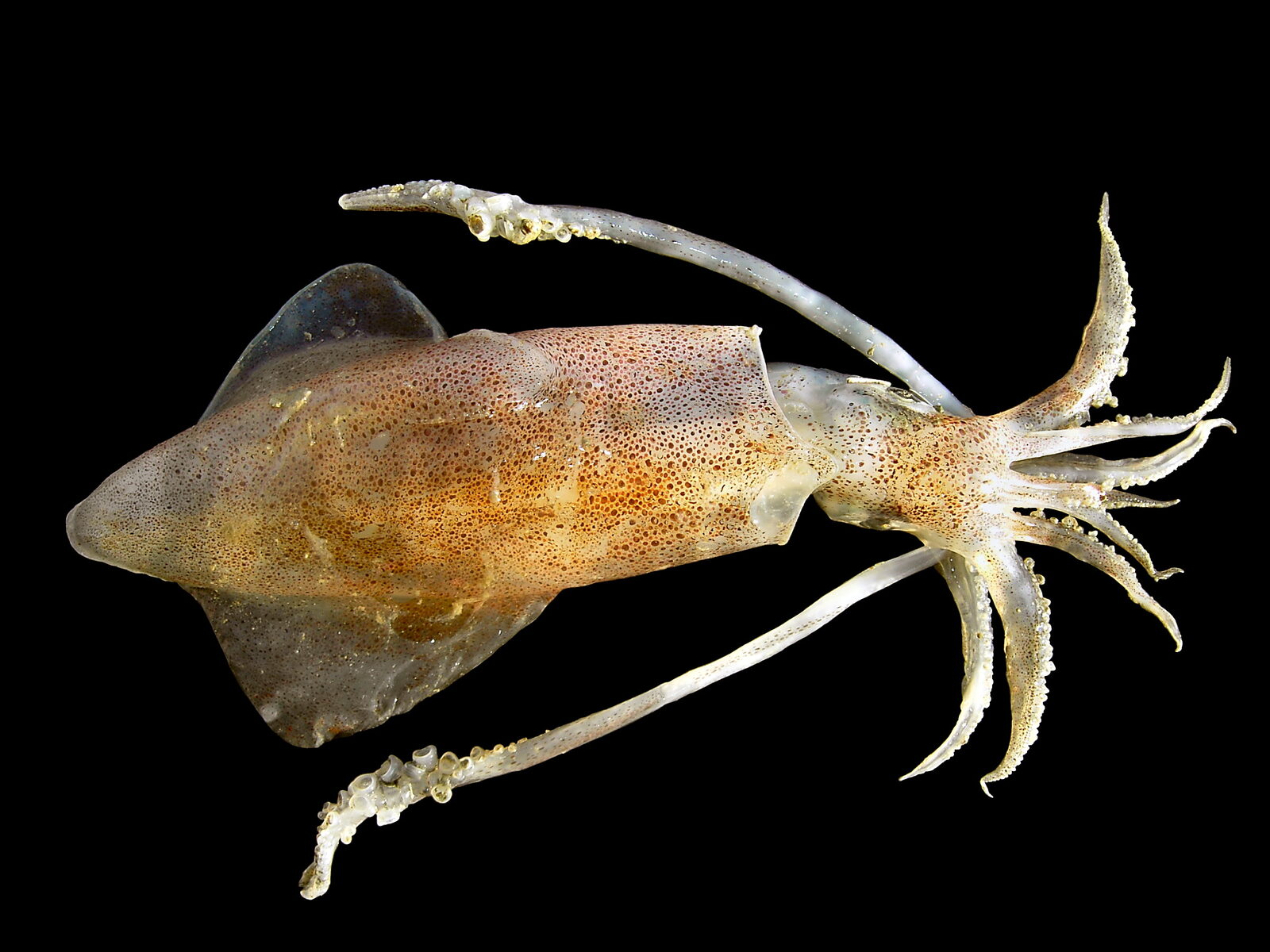
Common squid occur throughout the Adriatic. They have an elongated mantle and substantial diamond-shaped fins; their colour can change rapidly, so a pink, pale or mottled appearance is not a reliable identification by itself. The similar veined squid, Loligo forbesii, requires closer examination. In common squid the central suckers on the expanded tentacle clubs are conspicuously larger than the outer ones. Do not identify a hurriedly handled animal from colour alone.
This is a mobile predator, not a fish tied permanently to one rock. Fish, crustaceans and other cephalopods form its diet. A squid jig offers a prey-sized object to investigate and seize; it need not duplicate a particular local shrimp. Common squid use continental-shelf water, including sandy and muddy areas, and move both vertically and horizontally. Shore anglers can reach only part of that habitat.
For a concrete shore-planning base, consider Brela on the mainland Dalmatian coast. Its tourist board publishes local sea-fishing and permit guidance; use that to identify an open stretch outside harbour operations and restricted bathing areas, then look for a reachable sand-and-rock boundary. The guidance verifies a local fishing framework, not a particular squid hot spot. Confirm the exact bank and any local signs before casting. Regional occurrence is also documented by historical central-Adriatic research using Split fish-market samples; landings do not establish shore catch rates. A marina pontoon or ferry berth is not automatically available to anglers.
Look from an accessible shore for clean sand beside rock, the outer edge of vegetation, or a gradual slope into deeper water. These boundaries offer contrasting backgrounds and routes for small prey. Choose a place where the jig can cross an edge without spending every pause inside weed. If a sheltered bay is too shallow to work a sinking jig, its outer slope may offer a more controllable presentation. That is a search hypothesis to test, not proof that squid are waiting there.
Season, light and forage
Spawning can occur through the year, with stronger winter–spring activity reported in Adriatic biological accounts. This does not turn every winter evening into a feeding window. Local temperature, water clarity, prey distribution and the depth reachable from shore may matter more than the date on a calendar. Historical winter landings also reflect fishing effort and cannot supply an hourly bite forecast.
Try a session spanning the transition from daylight to dusk when lawful and conditions allow. It gives you daylight to inspect the bottom and a second light condition to compare. Squid may also feed in daylight; do not abandon good depth control simply to fish after dark. Existing ambient light can reveal small prey, but do not assume every illuminated quay is legal, accessible or productive. Adding a fishing light raises separate Croatian permit and gear questions.
Watch the water for baitfish movements and note the layer in which any followers appear. A squid following high in the water has supplied more useful information than a calendar slogan. Shorten the next countdown and work that layer again. A lack of visible prey is less informative in deep or coloured water, where observation covers only a small fraction of the scene.
Assemble one outfit you can control
A useful light shore starting outfit is a 2.3–2.6 m eging or light spinning rod rated for the actual jig weight, a smooth-drag 2500-size reel, and roughly 8–12 lb braid. Reel size labels vary between manufacturers. Add about 1–1.5 m of 10–15 lb abrasion-resistant leader with a suitable braid-to-leader knot, then tie a small egi snap to the leader. Clip on one squid jig. Check knots under steady tension and inspect the last section after contact with rock.
The jig carries its own ballast and rear hook crowns. It does not need a baited fish hook, a long branching trace or an extra sinker for this starting rig. Extra hardware changes its balance and sink behaviour. Keep the drag moderate: the aim is sustained contact through the squid's arms, not the abrupt hook-set used to drive a heavy fish hook through a jaw.
Carry a normal-sinking egi around size 2.5–3.0 and a slower-sinking alternative. These are size conventions, not universal gram weights. For a concrete reference, an EGI-OH K size 2.5 is specified at 11 g and approximately five seconds per metre under its test conditions. Other models differ. Read the package and stay inside the rod's casting range; a number such as 3.0 alone is insufficient to establish weight.
A compact landing net with enough reach is more useful than planning to lift a heavy squid up a wall on the leader. Put the net where it can be used from your chosen position before casting.
Choose the jig for the route
| Water or observation | Starting choice | Presentation to test | Change when |
|---|---|---|---|
| Clean sand outside a rocky margin | Normal-sinking size 2.5–3.0 egi | Controlled sink, two short lifts, then a pause above the bottom | Repeated bottom contact means shorten the count |
| Shallow weed edge | Slow-sinking egi of suitable casting weight | Short count and low-amplitude lifts over the plants | Weed on the crowns means work higher or move outside |
| Reachable deeper slope with modest flow | Faster-sinking model within rod rating | Cast slightly against the drift and follow the line | A large line bow means shorten casts before adding weight |
| Visible follower high in clear water | Smaller profile or slower-sinking alternative | Shorter sink, restrained movement and a longer visible pause | No commitment after several controlled passes means change angle |
| Strong sideways wind or surging water | More sheltered position | Short cast with little loose line exposed | If contact remains poor, change location rather than guessing depth |
Colour is a secondary experiment. In clear water compare a restrained, translucent or natural-looking finish with a more conspicuous one; in poor visibility try a stronger silhouette or contrast. These are visibility hypotheses, not verified Croatian colour rules. Compare colours at similar depth and speed. Changing weight, sink rate and colour simultaneously makes the result difficult to interpret.
Learn the sink before adding action
Make the first cast short over the clearest bottom available. Close the bail, recover excessive slack and let the jig sink with a slight bow in the line. An entirely tight line can pull it toward you; an uncontrolled loop conceals both bites and bottom contact. Watch where the line enters the water and count consistently.
A nominal five-seconds-per-metre jig would take about fifteen seconds to descend three metres in idealised conditions. That is an arithmetic illustration, not a depth measurement: current, leader drag and line tension alter the actual descent. Start shorter than your estimated bottom time, especially near rock. Add a few seconds on successive casts only while the route remains clear.
Use one or two short upward rod movements, recovering the slack they create, then stop moving the rod and let the jig sink again. Think of the lift as attracting attention and the pause as giving the squid a chance to seize the lure. Hard, continuous whipping removes that pause and makes contact harder to read.
Cast a little against the observed drift so the jig crosses the habitat edge while sinking. If the line sweeps rapidly sideways, shorten the cast or move to a more sheltered angle. A heavier jig can improve control but also reaches snags sooner. Make that trade deliberately.
Detect a take and land it
A take may feel like increasing weight rather than a sharp knock. The line may tighten unexpectedly, move sideways or stop sinking before your usual count. Wind smoothly until you feel sustained resistance, then lift the rod progressively. Avoid a violent strike. If there is no weight, continue the retrieve and note where the interruption occurred.
Keep a gentle bend in the rod while winding. A squid's pulses can feel quite different from a fish's run. Allow the drag to absorb them rather than pumping the rod hard. Lead the squid over the submerged net and lift with the net; slack line during the final approach can let the crowns fall free.
A worked ninety-minute session
Spend the first fifteen minutes in daylight identifying a clear sand lane, an adjacent rocky edge and a deeper route reachable from the same permitted position. Start with the normal-sinking size 2.5 egi, the leader described above and a deliberately short countdown. Cover near water before making longer casts across it.
For the next twenty minutes, compare three cast directions while keeping the countdown and lift–pause rhythm consistent. If one direction produces snags, shorten its count and mark the obstruction mentally. Do not use the snag as a reason to drag harder.
Next, test the deeper route with a slightly longer sink, provided the jig still travels cleanly. If a squid follows halfway back, return to the depth where it appeared, reduce the next lift and extend the pause. If only weed appears, switch to the slow-sinking jig or fish the clean outer edge.
Use the final half-hour around changing light to revisit the best-controlled route. After several quiet, repeatable passes, change one variable: depth first, then pause length, then profile or colour. If none produces evidence, move to a second permitted position with a different depth rather than spending the entire visit changing paint finishes.
Local rules and brief handling note
Croatia requires the appropriate marine recreational or sport-fishing licence; shore access, permitted gear, protected areas and the use of artificial light need separate checking. Use the current Croatian government guidance and adopted rules in the source list before the trip. This guide does not establish permission for any harbour or authorise an added light.
Use a stable position away from vessel operations and wave wash. Keep hook crowns clear of hands and others. Handle retained squid promptly for food quality; if releasing, minimise handling and return it without leaving it on a dry surface. End the session when footing or line control deteriorates.