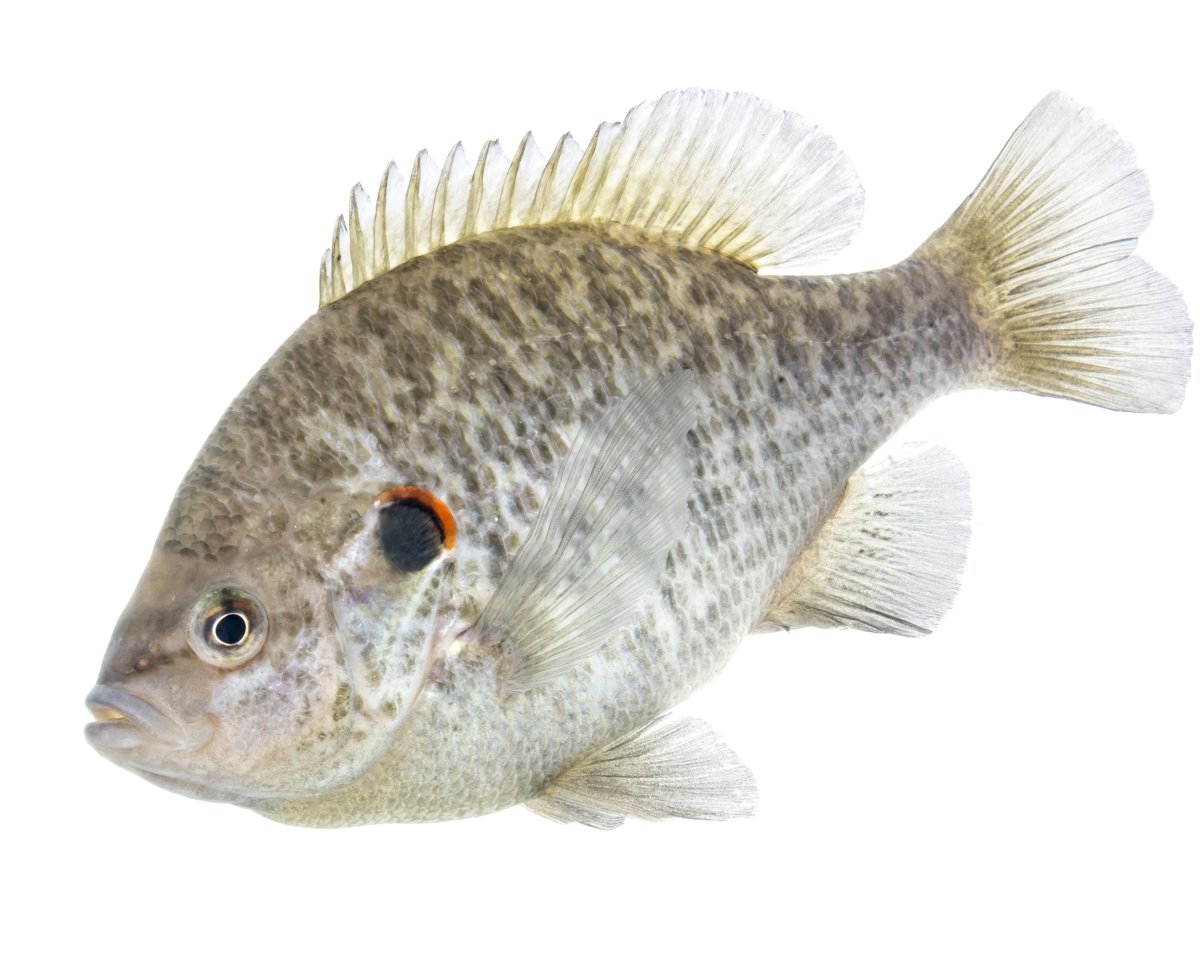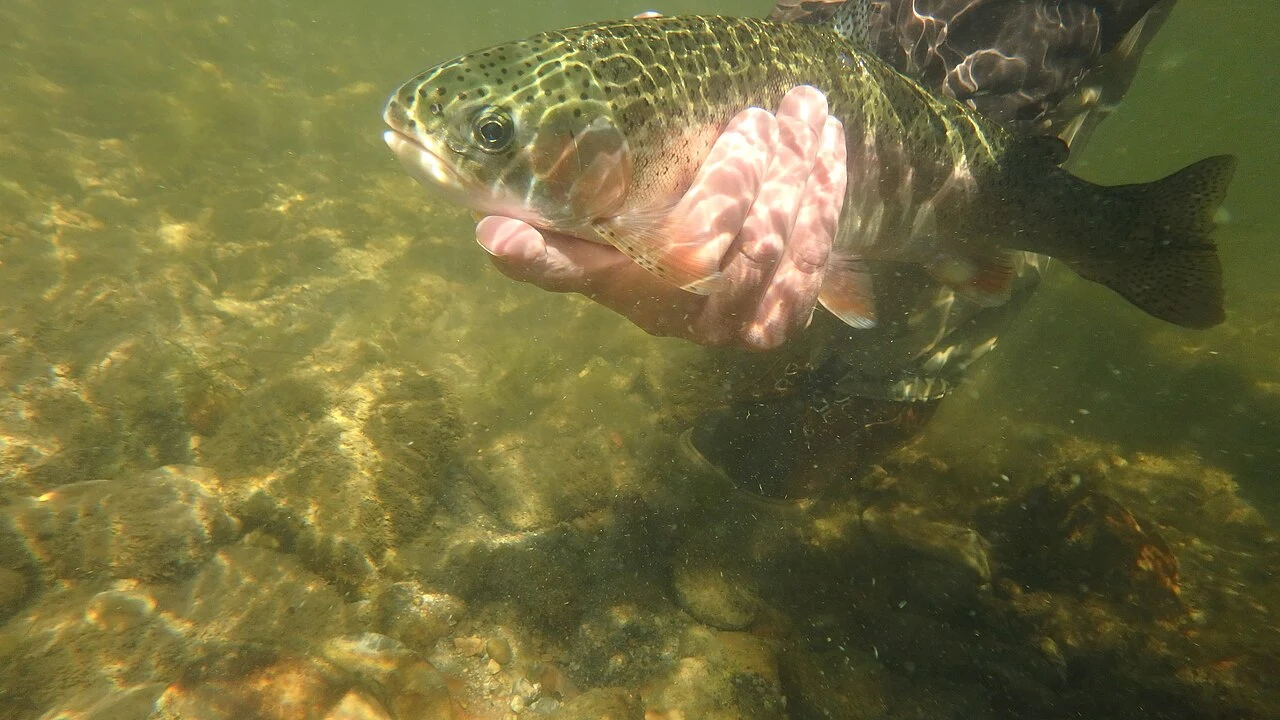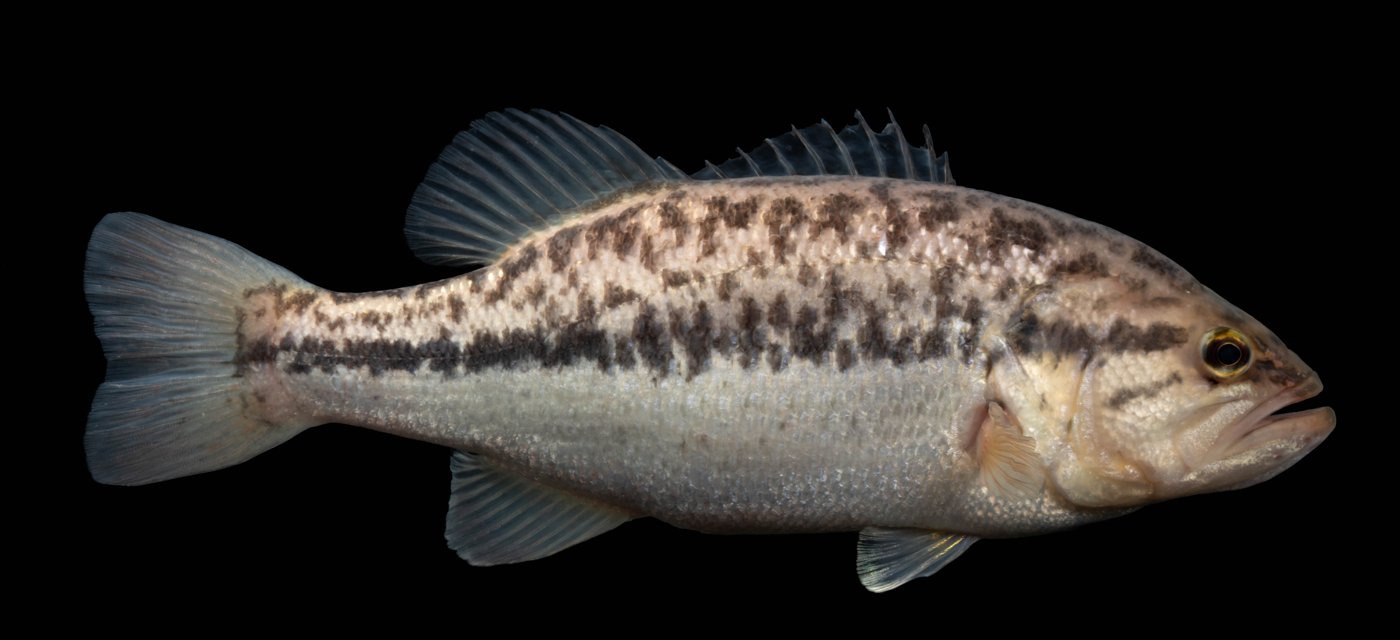
A first largemouth-bass session needs a search plan more than a large lure collection. This guide focuses on bank fishing a small lake or pond in North America, with legal access, moderate fish and manageable cover. Dense vegetation, major rivers and large offshore reservoirs require different equipment and decisions. The tackle below is an illustrative starting outfit, not a universal bass specification.
Know the fish and the water
Largemouth bass, Micropterus nigricans, are distinct from Florida bass, Micropterus salmoides. Older sources often use salmoides for largemouth or describe Florida bass as a subspecies. Do not translate an old scientific name into a new identification without checking the source's scope. Florida bass and largemouth cannot reliably be separated by appearance alone; genetic testing is needed for certainty. In other black-bass comparisons, the adult largemouth's upper jaw extending behind the eye and deep notch between dorsal sections are useful clues, but local identification guidance still matters.
These bass occupy lakes, ponds, reservoirs and slower river habitats across much of North America, with many introduced populations. This is not a claim that every pond contains them. Texas reservoir examples below describe fisheries managed under the familiar largemouth label, including stocked Florida ancestry; they are fishing examples, not genetic identifications. Smallmouth bass are a separate species and can use rocky water in the same reservoir.
Young bass initially eat tiny drifting animals and insect larvae; larger bass increasingly take fish and substantial invertebrates such as crayfish. Plants, roots and branches can conceal an ambush while adjacent open water gives prey somewhere to move. A paddletail searches for fish-oriented responses; a slow worm is a controllable alternative, not proof that wild bass chiefly eat earthworms. Do not infer today's diet merely from a productive lure.
Check whether the lake has public bank access, whether that access is continuous, and whether any shoreline areas are closed. A legal fishing licence does not authorize crossing a private lawn. Choose a stretch where you can land a fish without climbing over a barrier.
Read cover and structure separately
Cover is an object or vegetation associated with a fish's position: a log, plants, a dock or overhanging shade. Structure describes the shape of the lake bottom, such as a point, channel edge or change in depth. A vegetation edge beside a drop-off combines the two, but you do not need a boat and electronics to start making observations.
From the bank, identify three reachable features. One might be the outside of a weed bed, another a point and a third a shaded open pocket. Look for small fish or surface activity, but do not interpret every splash as feeding bass. Make the first casts nearby; marching to the edge and immediately casting across the lake can disturb the water within easy reach.
Season changes where this search should begin. Spring, summer, autumn and winter do not occur on the same schedule in Ontario and Florida. At Wheeler Branch Reservoir near Glen Rose, Texas, spring and autumn are documented productive periods. Wheeler Branch Park provides fee-based shoreline access; its clear water has rock, flooded trees and brush, rather than the weed beds used in the general examples below. Use that as a local example, not proof of a continent-wide calendar or a current catch report.
Build a manageable starter outfit
For open water and sparse cover, consider a 6½–7 ft medium-power spinning rod, a matching 2500–3000-size reel and 8–10 lb nylon. Reel size labels vary between manufacturers; balance, line capacity and the rod's printed lure range matter more than the number. Choose lures whose total rigged weight fits the rod.
Carry two presentations: a small paddle-tail soft plastic on a jighead for searching, and a Texas-rigged worm for working a chosen feature more slowly. Add suitable pliers, cutters, spare terminal tackle, a rubber-mesh net and a small litter container. A second rod can be convenient later, but it is not necessary for learning these jobs.
This outfit is not intended to force large bass out of thick mats or heavy timber. Avoid casting into cover you cannot fish effectively with it. Ask a local shop to match a stronger setup if heavy-cover fishing is the goal, rather than adding stronger line to an unsuitable rod and hook.
Search with a straight-running soft plastic
An example search bait is a 7–10 cm paddle-tail on a 3–7 g jighead, adjusted for depth, wind and the rod rating. A size 1–2/0 hook is a practical starting range, chosen against the actual plastic so the bend does not pin its tail. Hold the hook beside the bait, mark its exit, push into the nose and bring the point out centrally on the back. Thread the body straight so it swims without rolling. In a clear, safe margin, watch it on a short retrieve before casting to the feature. You should be able to describe its depth and action.
Fan casts across open water around the feature, beginning with short casts. Retrieve steadily enough to keep the lure working, then try a slower pass or a different countdown where snags permit. Keep the angle and lure consistent long enough to compare the change. Retrieve parallel to a weed edge when your position allows it; that keeps the lure near the chosen boundary for more of the cast.
If the lure repeatedly collects weed, first fish above the plants or change the angle. Dragging a fouled lure through the same route teaches little. Avoid excessive weight merely to cast farther; it can make a shallow presentation too fast or snag-prone.
Slow down with a Texas-rigged worm
A useful practice example is a 10–15 cm soft worm on a compatible offset worm hook, often around 2/0–3/0 depending on the actual bait. Hook sizes are not standardized between every product. The hook needs enough gap to expose the point when the plastic compresses, without overwhelming the bait.
Thread a small sliding bullet weight on the line with its narrow end facing the rod, then tie the hook. A light 1/8 oz, about 3.5 g, weight is a starting example for shallow, sparse cover; adjust or omit weight when the presentation and rules call for it. Push the hook point into the worm's nose for a short distance, bring it out below, slide the nose up to the hook's offset shoulder, then rotate the hook so the point faces the body. Lay it alongside to locate the second entry; push the point through and lightly tuck its tip under the skin. The worm should hang straight, with enough space to collapse away from the point. Do not bury it so deeply it cannot penetrate.
Cast beside the feature, let the rig settle while watching the line, then make a short lift or slow draw. Pause and repeat. A sideways line movement or unexpected weight can be a bite. Reel away excess slack and make a controlled, firm sweep appropriate to the hook and rod. Do not give a fish a long deliberate delay to swallow the bait.
Connect a feature to a presentation
These are starting experiments for accessible sparse cover, not guarantees of fish at every feature. At Wheeler Branch, published seasonal depth guidance ranges from shallow spring water to deeper winter positions; a bank angler may not reach every useful depth. Moving to a legally accessible angle is more useful than pretending a longer cast reaches an unmeasured channel.
| Feature or condition | Holding or feeding reason | Starting method | Presentation | Change or caveat |
|---|---|---|---|---|
| Outside weed edge | Concealment beside small-fish movement | Paddletail jig | Cast parallel and swim above leaves | Shorten sink if it returns fouled |
| Scattered wood with open lane | Ambush shelter beside passing prey | Light Texas worm | Land beside wood, pause, draw slowly | Avoid timber exceeding line strength |
| Rock-to-soft-bottom transition | Possible prey route, including crayfish | Worm or compact jig | Short lifts with controlled pauses | Reduce weight if wedged repeatedly |
| Open point beside deeper water | Route between depths | Searching plastic | Fan short-to-long casts with repeatable counts | Bank access may not reach winter fish |
With 8–10 lb nylon in clean water, tie directly to the jig or worm hook; a separate leader is not compulsory. For light abrasion, a practical replaceable section is 60–90 cm of 10–12 lb mono, with a joining knot learned and tested for those diameters. This does not turn the outfit into heavy-cover tackle. An improved clinch at the hook begins with the tag through the eye, five to seven wraps around the standing line, back through the small eye-side loop and then the larger loop. Moisten, draw down neatly and test before trimming.
Begin with a natural-looking green/brown worm or pearl paddletail. In stained water, compare a more visible dark or chartreuse option beside the bank; the test is visibility and control, not a universal color law. Low light can make a surface lure worth trying where fish are visibly active, but daylight can remain productive around shade or deeper edges. Wind may move food and improve cover for your approach while making slack harder to manage. Shorten casts before adding weight indiscriminately.
For the jig, start with a brief two-second count in shallow clear lanes, then extend only while it remains controllable. A count is not a measured depth. Wind slack out after a tap or sideways movement and lift firmly. For the worm, pause several seconds after a short draw; after repeated unproductive clean passes, compare a different feature or depth. Natural bait can catch bass where legal, but it adds bait-sourcing and deep-hooking considerations; the two artificial methods are the simpler release-oriented lesson here.
Use a simple two-hour plan
Spend the first ten minutes checking access, conditions and three features. Use the searching lure to compare the first two, then work the most promising feature more slowly with the worm. Move when you have tested an angle and depth deliberately, rather than waiting indefinitely or changing colors every cast.
For the final part of the session, revisit one feature with a specific change: a parallel cast, a slower retrieve or a different running depth. Record what you actually observed, including no bites. A follow is useful information, but one following fish does not establish that every fish in the lake wants the same adjustment.
Troubleshoot before buying more tackle
- Repeated snags: reduce weight, change the casting angle or choose more manageable cover.
- Soft plastic spinning: rethread it straight and check whether the hook is centered.
- Missed bites: inspect hook sharpness and exposed gap, remove excessive slack and review the timing of the strike.
- No activity: compare a different feature or depth before making endless color changes.
- Fish breaking off: inspect line damage, knots, drag and whether the cover exceeds the outfit's capability.
Handle the result carefully
Have the net and tools ready before fishing. Keep the fish wet, avoid gill contact and support its body when a brief lift is necessary. Support a horizontal bass beneath the body as well as controlling the lower jaw. Do not lever the jaw sideways to hold the entire fish horizontally.
Avoid targeting visibly spawning fish or disturbing nests. Check current local seasons, size and bag limits, hook restrictions and any temporary closures before deciding whether a fish may be kept. Texas Parks and Wildlife's linked Wheeler Branch rules include special bass limits and pole-and-line-only fishing; check that water-specific entry rather than assuming statewide limits. End the session with a short record of the habitat, rig, retrieve and conditions. That combination, rather than the lure's brand name, is the lesson to carry into the next visit.