A tide table helps you plan when to arrive. The moving water in front of you decides how to present the lure. Keep those two jobs separate: a predicted high-water time does not automatically tell you when current stops at a nearby channel, and a large tidal range does not guarantee the best bite.
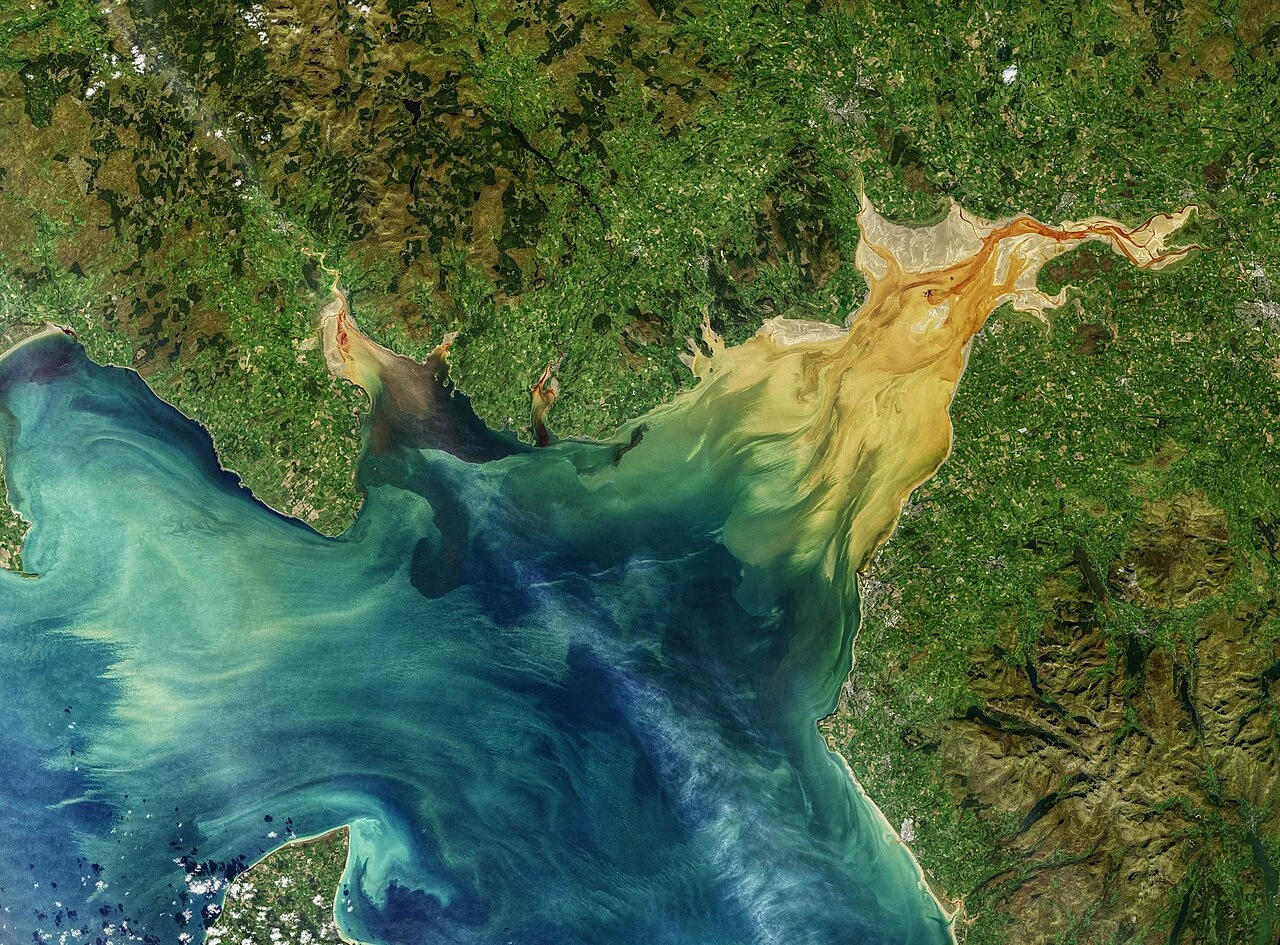
This is a general guide to reading tidal habitat, with a Texas bay example to make the tackle decisions concrete. The Solway Firth image illustrates tidal water and sediment; it is not a photograph of the Texas example. Fish species, access and productive seasons differ between estuaries.
Read height and current as different information
Tide height is the vertical level of the water. Current is horizontal movement. A place may have a large rise and fall but a manageable current along one shore, while a narrow passage can concentrate a powerful flow. Wind, river discharge and the shape of the basin also affect what you see.
High and low water describe the extremes of the height cycle. Slack refers to weak or reversing tidal current at a particular location. Their times need not coincide. In some places slack occurs near high or low water; elsewhere it does not. Use a current prediction for the relevant station when available rather than converting a nearby tide-height chart into an exact flow forecast.
Check the station name, date, time zone, units and reference level. A prediction at a harbour is a reference, not a depth chart for an adjacent flat. A charted depth and a tide height can only be combined meaningfully when their reference levels are compatible. For a shore-fishing session, it is often more useful to know whether the margin is flooding or draining than to claim an exact depth you cannot measure.
Turn the forecast into a fishing question
Instead of declaring that the last two hours of a falling tide are always best, ask what water will leave a particular creek and where small prey could go. On a rising tide, ask which previously shallow margin becomes accessible to fish. In either case, identify a route that your lure can follow while remaining under control.
Wind blowing across your casting line can produce a large belly even when the water current is modest. Shorter casts and a lower rod position may improve contact. Wind can also alter water levels and clarity. Observe these effects rather than treating the predicted curve as an assurance that conditions match it.
Use low light as a comparison, not a rule. Dawn, dusk, cloud and clear sunshine change visibility for predator and prey, but the best presentation still depends on local species and habitat. No universal moon phase, clock time or colour choice can replace checking where the food and fish actually are.
A regional example: Texas bay seatrout
Spotted seatrout, Cynoscion nebulosus, provide a useful example in Texas bays. They use habitats including grass, oyster reef and marsh margins. Smaller fish commonly take shrimp and small fish; larger individuals can rely more heavily on fish prey. Those differences justify comparing a small shrimp presentation with a larger swimming lure, rather than assuming every trout wants the same mouthful.
Spotted seatrout are not freshwater rainbow trout, and the word trout alone is not enough identification. Other coastal fishes may occupy the same water. Use the current local identification and rules guidance before retention. The tactics below are illustrative for a bay with established seatrout populations, not a claim that seatrout occur in the Solway Firth or every tidal river.
Start with a legal bank or pier position offering access to a marsh drain, grass edge or open channel margin. The source information verifies habitat use across Texas bays; it does not verify a current open casting position at every named shoreline. Establish public access separately and do not fish through boats or private docks to reach a promising line.
Match structure to a controllable presentation
| Structure and condition | Fish example where present | Food or holding reason | Method and presentation | Caveat |
|---|---|---|---|---|
| Marsh drain on an outgoing flow | Spotted seatrout in Texas bays | Small fish and shrimp may move out with draining water | Swim a small paddletail across the outside seam, casting slightly upstream | Fish the edge rather than assuming the fastest centre holds fish |
| Flooding grass margin | Seatrout in suitable bays | Increasing depth opens access to prey around vegetation | Suspend a shrimp or small jig above grass and drift along the clean edge | Too much leader puts the hook into plants |
| Oyster reef edge | Seatrout where present | A change of substrate and depth can concentrate prey routes | Work a lightly weighted lure over the edge with brief pauses | Shell cuts leader; avoid dragging and inspect abrasion |
| Channel beside a shallow flat | Local estuary predators | Depth provides an alternative as the flat drains or cools | Compare progressively longer lure countdowns from a secure bank | Channel depth is not established by surface colour |
| Eddy beside a point or obstruction | Species depend on the estuary | A slower pocket sits beside moving prey | Drift along the entry seam, then test the exit separately | Surface rotation can conceal difficult subsurface flow |
The table is a set of testable routes. A fish may sit beside a feature because of shelter, food, temperature or a combination; visible current alone does not prove why it is there. When a feature cannot be reached cleanly, choose another rather than increasing weight indefinitely.
Assemble a swimming-jig outfit
For the Texas example, a 7 ft medium-light or medium spinning rod, 2500–3000-size reel and roughly 10–15 lb braid make a practical starting outfit. Tie on about 60–90 cm of 15–20 lb leader with a suitable connection knot, then attach one jighead. Use the stronger end where shell abrasion matters, while keeping tackle balanced enough to land the expected fish promptly.
Begin with a 1/8 oz jighead and a 7–10 cm paddletail. A 1/4 oz head is an alternative when depth or flow prevents control, provided the total lure weight suits the rod. Jig hook sizes around 1/0–3/0 are illustrative; match the hook to the plastic so the tail remains free and the point exits cleanly. Thread the nose onto the hook, bring the point out at the marked exit position and push the body snugly against the head without bending it.
Cast slightly upstream of the intended crossing point. Close the bail, recover excessive slack and use a short initial countdown. Swim the lure across the seam with a steady retrieve, adding small lifts or brief pauses only while you can follow its depth. A pause makes a weighted jig descend; it does not merely slow the same horizontal route.
If it constantly catches shell, reduce sink time or weight and raise the working layer. If the current carries it out of the lane before it descends, shorten the cast or move upstream before trying a heavier head. A tap, sideways line movement or sudden weight calls for winding into contact and a firm, controlled lift.
Compare a shrimp under a float
A fixed popping cork offers a second presentation over shallow grass or shell. Attach the main line to the cork's upper fitting, tie roughly 45–90 cm of leader to the lower fitting, and finish with a suitable single hook around size 1–1/0. Hook sizes vary; choose one that fits the shrimp while leaving the point exposed. Set leader length to keep the bait above the vegetation, not to achieve an arbitrary distance beneath every cork.
Where locally permitted, a live shrimp hooked lightly through the shell near the tail can remain mobile. A small artificial shrimp or light jig is an alternative when bait is unavailable or you want a repeatable lure comparison. Use only enough weight to keep the offering in its intended layer without overwhelming the float.
Cast upstream and let the float travel toward the edge. Make a short pull to disturb the cork, recover slack and allow a pause. Compare several seconds of quiet drift with a more frequent pull rather than churning continuously. Keep line off faster water that would tow the float away from the target.
A disappearing or decisively travelling float may indicate a take. With a conventional J-hook, wind down and lift smoothly. If a legal circle-hook arrangement is chosen instead, maintain pressure and wind rather than striking sharply; the hook-setting approach must match the hook. After repeated missed bites, reduce slack and check bait size and hook exposure before assuming the fish are too small.
Choose colour and speed for a reason
Begin with a natural-looking or translucent lure in clear water and compare a stronger contrasting silhouette when visibility is poor. These are practical starting tests, not evidence that a particular colour wins in every Texas bay. Water depth and light alter appearance, while a lure that is fouled with grass is not presenting its intended shape at all.
A faster retrieve may keep a lure above vegetation; a slower one may bring it closer to the bottom. Change jig weight if you need a slower speed without sinking into cover. Think of speed and depth together. Trolling-speed numbers from a different fishery do not help a shore angler trying to hold one marsh seam.
A worked two-hour shore session
Arrive while there is enough light to identify the edge, your landing position and the return route. Note the observed direction of surface movement and compare it with the relevant prediction. Start with short casts to near water before covering the far seam.
For twenty minutes, use the 1/8 oz paddletail rig at a short countdown. Cover three directions while keeping speed similar. Then increase the countdown slightly only on clean routes. Record a follow, strike, snag or weed contact separately; each supplies different information.
For the next half-hour, put the float presentation along the most promising shallow edge. Set the leader to remain above the plants, compare a quiet drift with occasional pops, and watch whether the float is being towed by your line. If it is, shorten the cast.
As the current weakens or reverses, reassess the feature. The productive side of a point can change. Recast from a position that lets the offering approach naturally, rather than repeating the original angle because it worked earlier. After no response, change layer, then angle or speed, then profile; move to a second reachable feature when the first has been covered properly.
Finish by recording the station used, observed flow, clarity, lure weight, countdown and response. A single quiet session cannot establish a poor tide, but several comparable sessions can improve your own local plan.
Short rules and safety note
Check the relevant fisheries authority's current licence, species limits, gear rules and closures, plus land or pier access. The Texas example does not establish rules elsewhere. Confirm those details before choosing bait or retaining fish.
Keep a return route clear of rising water and avoid unknown mud, channel crossings, wave wash and vessel traffic. Tide predictions are not a weather forecast. Land fish promptly and keep released fish wet and supported; leave when footing or presentation control becomes unsafe.