Florida pompano are built for moving water. Their compact silver bodies, narrow tail bases and deeply forked tails suit a life along beaches and nearshore bars, where waves uncover small crustaceans and other prey. For the winter surf angler, that means mobility and beach reading are more useful than waiting beside rods placed in featureless water.
This guide addresses the Florida Atlantic coast as a broad planning area, not one guaranteed beach. Conditions differ sharply between inlets, guarded swimming beaches, state parks and open public access. Confirm local access hours, parking, bait rules and any site-specific closures before setting up.
The Florida Fish and Wildlife Conservation Commission’s current statewide rule page, checked on 25 October 2026, lists Florida pompano at an 11-inch minimum measured to the fork of the tail, a daily recreational bag limit of six per person, and an open year-round season. It lists hook and line, cast net and beach or haul seine as allowable harvest methods, and prohibits a multiple hook used with live or dead natural bait. Special rules apply in Biscayne Bay and Biscayne National Park. Reopen the official page before every trip because rules can change and local areas may add restrictions.
Identify the fish before measuring it
Florida pompano and permit are related jacks and are commonly confused. That matters because the regulations are not the same. FWC’s identification material should be used rather than a quick guess.
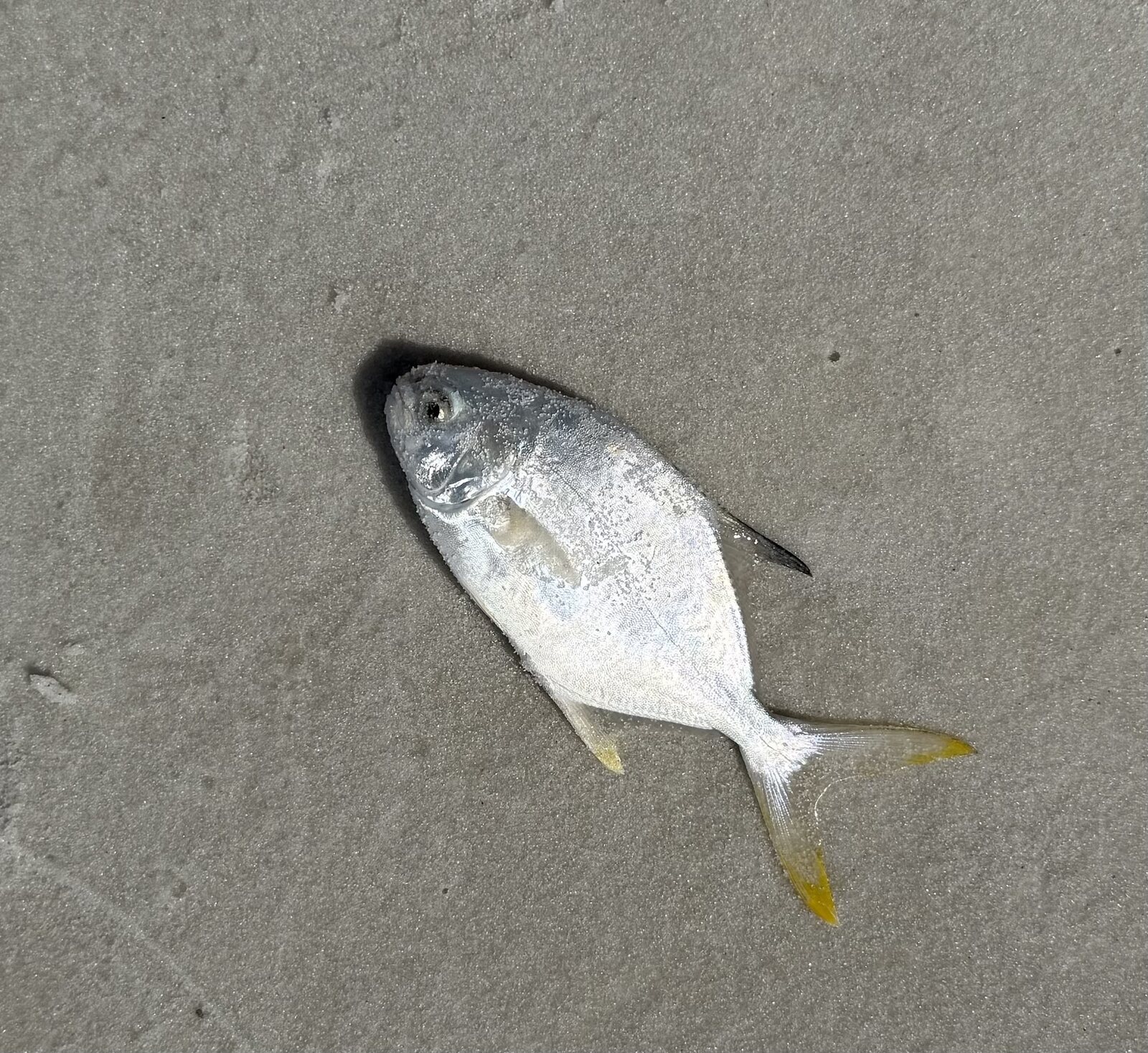
A Florida pompano generally has a short, blunt snout; a deep, laterally compressed silver body; yellowish colour on parts of the fins; and no obvious dark spot behind the pectoral fin. The dorsal and anal fins do not form the long sickle-like lobes typical of an adult permit. Size alone is not a safe separator.
Measure a suspected pompano to the fork of the tail in the manner specified by FWC. If the identity or measurement is uncertain, release the fish promptly. Do not carry an uncertain fish back to a cooler for later identification.
Read the beach before casting
Arrive with enough daylight to observe wave shape and water colour. A uniform line of breaking waves often marks a bar. Darker or smoother water can indicate a trough, a cut through the bar or greater depth. Foam, sand and floating material moving steadily seaward may indicate a rip current. That rip can concentrate food, but it is also a hazard.
Useful casting targets include the inside edge of the first bar, the adjacent trough, the shoulders of a cut and a change where one wave line stops breaking. The longest cast is not automatically the best. Pompano sometimes feed in the first trough within an easy cast, especially when surf energy is moving food.
Walk before planting multiple rod holders. If legal access permits, make several exploratory casts from separated positions and note where the sinker settles rather than rolls. Once a zone produces bites or clear signs of life, slow down and fish it methodically.
Match the tackle to surf, not ego
A 9- to 12-foot surf rod rated for the chosen sinker gives casting distance and line control. Pair it with a corrosion-resistant spinning reel in roughly the 4000 to 6000 class. A practical main-line range is 15- to 25-pound braid, with a shock leader appropriate to the sinker and casting force. Inspect the leader after contact with shells, rocks or structure.
Sinker weight should hold the bait near the target without overloading the rod. In light surf, 2 or 3 ounces may be enough. Strong sweep may require 4 ounces or more and a shape that grips sand. If the only way to hold is beyond the rod’s rating, change position or postpone rather than casting an unsafe load.
Use small, strong circle hooks where lawful, often around size 1 to 1/0 depending on the maker and bait. Hook sizing is inconsistent between brands, so judge the actual gap. A pompano’s mouth is modest; an oversized bait can hide the hook point.
A simple legal bottom rig
A single-hook or two-drop surf rig can cover the water efficiently, but the current FWC restriction on multiple hooks with live or dead natural bait must be read carefully. Do not assume a commercially sold “pompano rig” is lawful for the bait and area being used. The most conservative approach is a single circle hook on a short dropper above a sinker until the regulation is fully understood for the planned presentation.
Use abrasion-resistant leader material around 15 to 30 pounds, adjusting for water clarity and shells. Keep droppers short enough to limit tangles. Bright floats or beads can lift bait above crabs and add visibility, but they are optional. One small colour accent is enough; a rig does not need to look like a chandelier.
Natural offerings commonly include sand fleas and pieces of shrimp or clam where their collection and use are legal. Artificial scented baits can simplify storage and may stay on the hook longer. Whatever the bait, use a small, streamlined piece so the hook gap remains open.
Cast a search pattern
Begin by placing baits at different useful distances: the near trough, the bar edge and the far side of a cut. If only one rod is used, rotate those distances rather than repeating the same cast. Note where the sinker lands relative to the breaking wave, not simply how many turns of line are recovered.
After the sinker settles, remove most slack and place the rod securely with a modest bend in the tip. Circle hooks work best when a fish loads the rod; an immediate overhead strike can pull the hook away. Lift the rod, reel steadily and keep pressure on the fish.
Small taps may be crabs, baitfish or a pompano testing the bait. Check at planned intervals. A stripped hook left for an hour is not fishing. Equally, reeling every minute prevents the bait from working. Ten to twenty minutes is a useful starting interval, shortened when bait theft is obvious.
If twenty or thirty focused minutes produces no bites and no signs, shift one variable: distance, position, bait size or rig visibility. Do not change everything at once. A move of 50 to 100 metres along an accessible beach can be more valuable than another tackle change.
Weather, tide and water clarity
Winter fronts reshape the Florida surf. A moderate onshore wind can create useful turbulence, while strong wind and large breaking waves make casting and wading hazardous. Offshore wind can flatten the nearshore water but may also change where food gathers. Check the marine forecast, beach forecast and rip-current statement on the morning of the trip.
Tide influences access to troughs and cuts, but there is no universal “pompano tide.” On a steep beach, rising water may bring fish close. On a broad shallow beach, a lower stage may reveal the shape of bars and cuts. Keep notes for the particular beach rather than applying a slogan to the entire coast.
Clean water is usually easier for pompano fishing than heavily muddied surf, but some colour and movement can be productive. Look for a fishable seam between clear and stirred water. Floating weed is often the practical limit: if every cast collects weed and sweeps sideways, relocate.
Rip-current and wave safety
The National Weather Service advises checking forecasts and swimming near a lifeguard. Anglers should apply the same caution even when they do not intend to swim. A wave can knock down someone standing only knee deep, and a rip can deepen a cut unexpectedly.
Do not wade to gain a few extra metres when the surf is strong, the bottom cannot be seen or a rip is active. Keep children and non-swimmers above the wash. Face the ocean while handling tackle near the water, and never turn a long rod or hooked rig toward people using the beach.
If caught in a rip current, remain calm, conserve energy and move parallel to shore until clear of the current before angling back toward land. Do not fight directly against the flow. Signal for help if needed. Fishing gear can be replaced; dropping a rod is preferable to carrying it into danger.
Lightning, heat stress and cold exposure also matter in Florida winter. A bright mild morning can turn windy and cool after a front. Pack sun protection, drinking water and a wind layer, and leave when thunder is heard.
Handling, release and harvest
Prepare a wet measuring surface and tools before the first bite. Keep the fish out of dry sand where possible, support it without squeezing the gill covers, and measure quickly. A fish under 11 inches fork length must be released. A legal fish need not be kept.
Pompano are fast swimmers but can be exhausted by a long fight in rough surf. Revive a released fish facing into clean moving water while maintaining control, then let it leave under its own power. Do not drag it backward through the water.
For a retained fish, follow the current possession and transport rules, chill it promptly and keep each angler’s catch within that person’s limit. Do not combine limits into an unmarked group cooler. The six-fish bag is a maximum, not an instruction to harvest six.
Mistakes that waste a session
The first is confusing permit with pompano. The second is casting over fish that are feeding in the first trough. The third is using more sinker than the rod safely handles. A fourth is burying a small hook in a large lump of bait.
Many anglers also remain anchored to an attractive access point after the water has shown no life. Pompano travel; a mobile plan should allow at least two or three beach sections without trespassing or crossing closed dunes.
Finally, do not frame every lost bait or bent rod tip as a pompano bite. Crabs, whiting, small jacks and wave surge all create movement. Inspect the bait, note the pattern and identify every landed fish before applying a rule.
A practical four-hour plan
Check FWC regulations, the local access page, marine forecast and rip-current outlook before leaving. Carry one simple rig family, two sinker shapes, small hooks, a measuring board, dehooker, pliers, water and sun protection.
Spend the first fifteen minutes reading the beach. Fish three distances for about twenty minutes each, changing only one variable at a time. Move along the beach if the water is empty or weeded out. When a fish is landed, identify it first, measure it correctly and decide quickly whether to release it.
Stop before fatigue degrades casting safety. The best winter pompano session is not necessarily the one with the fullest cooler; it is the one in which the angler found a productive piece of moving water, obeyed the current rules and left the beach without putting anyone at risk.